



Education Journalist | Study Abroad Strategy Lead | Updated On - Mar 20, 2026
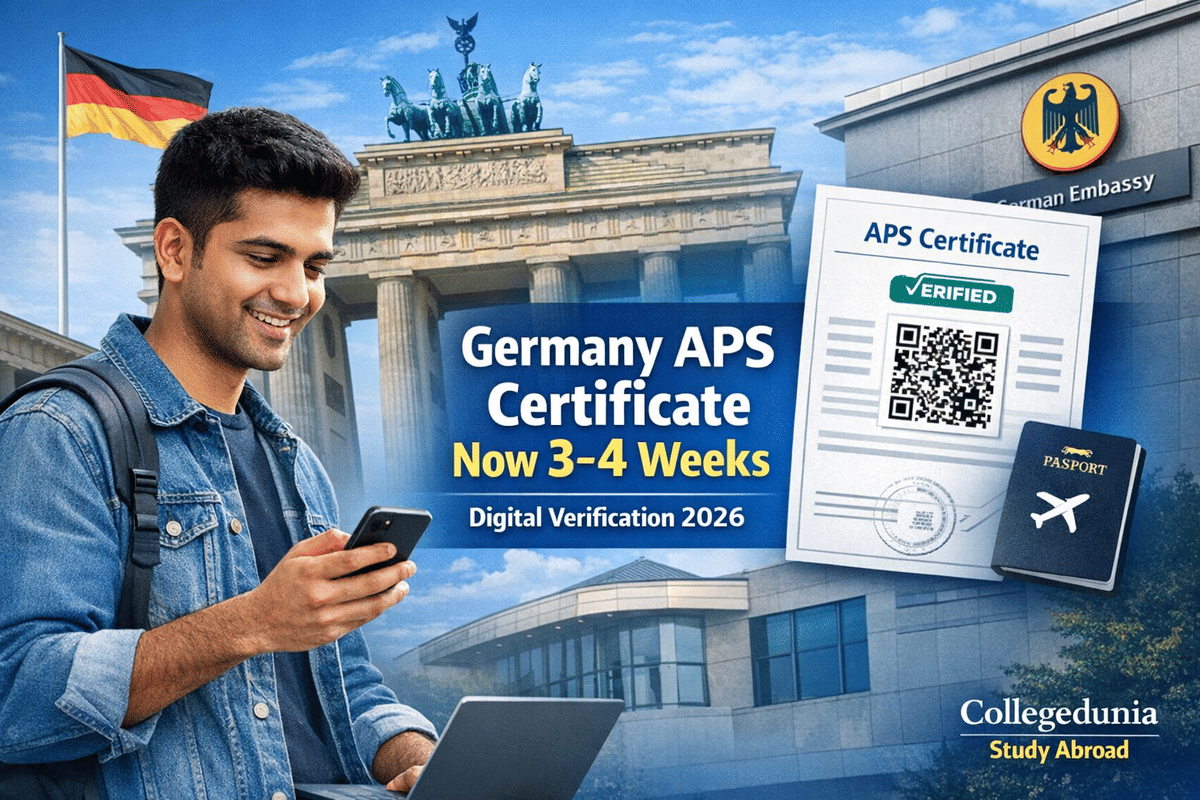
The single biggest bottleneck in the Germany study visa journey for Indian students — APS certificate processing — has been cut from 4–6 months to approximately 3–4 weeks, following a full shift to digital verification by the Akademische Prüfstelle (APS India) in 2026. For the tens of thousands of Indian students targeting a Winter Semester 2026/27 start, this is the most consequential process change in years.
APS certification is mandatory for most Indian students applying to degree programmes in Germany. Until recently, the paper-based system — requiring physical courier submissions, manual university verification, and no real-time tracking — routinely delayed the entire admission and visa chain by months. The 2026 digital overhaul changes that calculus entirely, and students who understand the new system and act now have a clear timing advantage.
Check details on Winter Semester in Germany
What Has Changed: From Paper Backlog to Digital Speed
The APS India office has moved to a fully digital submission and verification system in 2026. Paper applications are no longer accepted. All submissions now go through the official APS India portal at aps-india.de, with documents uploaded digitally, fees paid online, and certificates issued as QR-coded PDFs by email.
The impact on processing time is significant:
| Aspect | 2025 (Paper System) | 2026 (Digital System) |
|---|---|---|
| Processing time | 4–6 months | 3–4 weeks |
| Submission method | Physical courier to New Delhi | Digital upload via aps-india.de |
| Courier cost | ₹2,000–₹5,000 | None |
| University verification | Manual (slow, variable) | API / DigiLocker where available |
| Certificate format | Physical with hologram | QR-coded digital PDF |
| Real-time tracking | Limited or none | Live status in portal |
| Re-upload on rejection | Resend by post (weeks lost) | Instant re-upload, no extra fee |
Source: APS India (aps-india.de); German Online Tests analysis, March 2026
The most significant accelerator is DigiLocker integration. If your Indian university has uploaded your degree and transcripts to DigiLocker, APS can verify them near-instantly via API — bypassing the manual university contact process that previously added weeks to timelines. Students whose universities are on DigiLocker are reporting verifications in as little as 18–21 days.
The APS fee remains ₹18,000 (non-refundable), payable via the portal. The shift to digital has eliminated the additional ₹2,000–₹5,000 courier cost, bringing total APS expenditure down slightly.
Why Delays Were So Severe — and Why They Built Up?
The APS backlog that plagued Indian students between 2022 and 2025 was the product of two converging pressures: a dramatic surge in demand and a system not built to handle it.
Indian student enrolment in Germany more than doubled between 2018/19 and 2023/24 — from approximately 20,810 to nearly 60,000, according to data from the German Academic Exchange Service (DAAD) and the German Federal Statistical Office. India now ranks among the top two source countries for international students in Germany. In 2025 alone, student visa applications from India rose by 35%, according to the German Embassy.
The paper-based APS system was designed for a fraction of this volume. Each application required physical documents to be couriered to New Delhi, manually sorted, and then verified by contacting individual Indian universities — a process that could take weeks per case. During peak admission seasons (January–March and June–August), the backlog compounded, with some students waiting 5–6 months for a certificate that then had to feed into a separate 8–12 week visa processing queue.
The result: students who started the APS process in January for a Winter Semester start were routinely cutting it dangerously close — or missing the intake entirely.
What This Means for Indian Students Now
The digital shift makes Germany a significantly more predictable visa destination for Indian students — but only for those who understand the new system and apply correctly.
The revised total timeline for Winter Semester 2026/27 (October start):
| Step | Time Required | Deadline to Start |
|---|---|---|
| APS digital application | 3–4 weeks | By April 2026 |
| University application (Uni-Assist or direct) | 4–8 weeks | April–May 2026 |
| Admission letter received | Variable | June 2026 |
| German student visa (VFS/Embassy) | 8–12 weeks | By June 2026 |
| Blocked account setup | 2–4 weeks | Alongside visa |
| Total end-to-end | ~5–6 months | Start: March–April 2026 |
The old timeline required starting APS 6–8 months before the intake. The new timeline compresses that to 5–6 months total — but only if the APS step is completed in 3–4 weeks as expected. Students who delay past April risk pushing their visa appointment into August or September, leaving no buffer before the October semester start.
Germany's appeal has also strengthened relative to alternatives. With US F1 visa issuances to Indian students down 69% in summer 2025, and UK tuition costs rising, Germany's combination of low or zero tuition at public universities, a post-study work pathway (the Chancenkarte / Opportunity Card), and now a faster visa process makes it an increasingly rational choice for Indian students.
Who Is Affected
- Winter Semester 2026/27 applicants (October 2026 start) — must begin APS now; April is the last safe window
- Master's applicants in STEM, engineering, computer science, and MBA programmes — the largest cohort of Indian students in Germany
- Bachelor's applicants — note: APS may now require a TestAS score for students who have not completed a full Indian bachelor's degree; check aps-india.de for the latest requirement
- Students whose universities are on DigiLocker — eligible for the fastest verification track (potentially under 3 weeks)
- Students reapplying after a previous APS delay — the digital system allows faster re-submission if documents were previously rejected
Who is NOT required to get APS:
- Students with an International Baccalaureate (IB) or A-Level qualification as their highest degree
- Students holding a non-Indian foreign degree
- DAAD or Erasmus scholarship recipients (separate vetting applies)
- PhD applicants at universities that explicitly waive APS
What Students Should Do Right Now
- Apply for APS immediately at aps-india.de. Register, complete your profile, and select the correct procedure (Bachelor's or Master's). Do not use third-party "express" agencies — the official portal is the only valid channel.
- Link DigiLocker before submitting. If your university has uploaded your degree and transcripts to DigiLocker, link your account in the APS portal before submitting. This is the single most effective way to accelerate verification. Set up DigiLocker at digilocker.gov.in if you haven't already.
- Prepare documents to exact APS specifications. Upload files as PDF/A format, minimum 300 DPI, maximum 5 MB per file, colour scans, one document per file, no password protection. Rejections due to format errors restart the clock — avoid them.
- Pay the ₹18,000 fee via the portal. The fee is non-refundable. Save your payment receipt. Accepted methods include card, net banking, and UPI as listed on the portal — confirm before paying.
- Track your application daily. The portal provides real-time status updates. If APS flags a document issue, re-upload immediately — delays in responding extend your timeline.
- Begin your university application in parallel. Many German universities for Winter 2026/27 have application windows open now through April or May. You do not need the APS certificate in hand to begin applying — but you will need it before the visa stage.
- Open your blocked account early. A blocked account showing €11,208 (~₹10.4 lakh at current rates) is mandatory for the German student visa. Setup takes 2–4 weeks. Start this process alongside your APS application, not after.
- Do not wait for your APS certificate before booking a VFS appointment. German student visa appointments at VFS Global in India can have their own wait times. Book your appointment slot as soon as you have your admission letter — you can always reschedule if needed.

















Comments