



Education Journalist | Study Abroad Strategy Lead | Updated On - Apr 16, 2026
Priya spent INR 8.5 lakh on a 2-week Oxford summer program in 2025. She came back with a certificate, a group photo at the Bodleian Library and a LinkedIn post that got 400 likes. Six months later, she was still applying to the same jobs as her batchmates who had never left India. Arjun, meanwhile, spent INR 28 lakh on a one-year master's in the Netherlands. He had a job offer before he landed back in Mumbai.
That is not a knock on short-term global courses. It is a framing problem — and it is costing Indian students lakhs of rupees every year. The question is not "which is better." The question is: what do you actually need, and what will each option realistically deliver?
Here is the context that makes this decision more urgent in 2026 than ever before: the number of Indian students enrolled in universities abroad actually fell by 5.7% in 2025 — from 1.33 million in 2024 to 1.254 million — the first decline in three years. Visa rejections are up in the US (F-1 visas to Indian students dropped in the first half of 2025), Canada is issuing a fraction of the study permits it once did, and costs are rising everywhere. In this environment, choosing the right type of international education and spending your money on the option that actually delivers matters more than it ever has.
Check: Top Universities Abroad for Indian Students
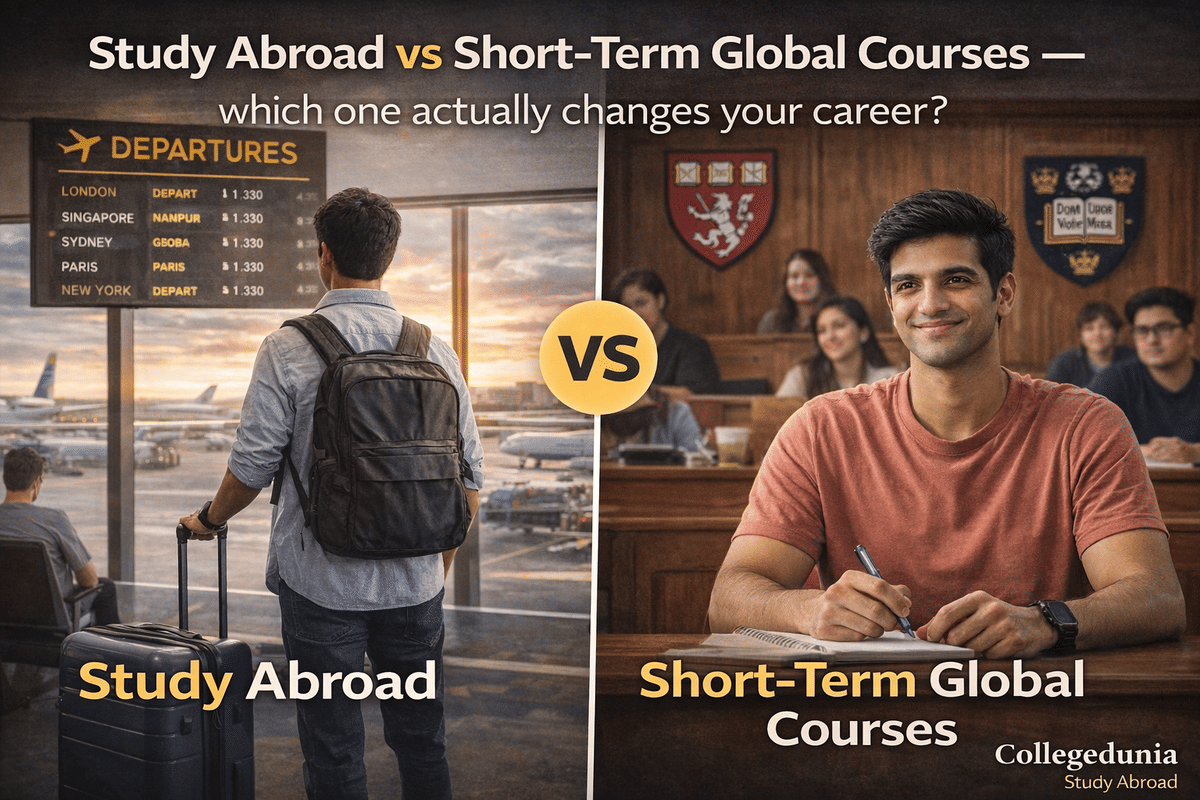
- Study Abroad vs Short-Term Global Courses: What Is the Difference?
- Cost Comparison: Full Study Abroad vs Short-Term Global Courses
- Career Impact: What Employers Actually Value
- Cultural Immersion and Personal Growth
- Which Option Is Right for You? A Decision Framework
- The Hybrid Strategy: Using Both Smartly
- Best Short-Term Global Courses for Indian Students in 2026
- FAQs
Study Abroad vs Short-Term Global Courses: What Is the Difference?
Study abroad and short-term global courses are not two versions of the same thing. They are fundamentally different experiences with different costs, different outcomes and different purposes.
Before comparing them, you need to know what each term actually covers — because "short-term global course" is an umbrella that includes everything from a 5-day leadership bootcamp to a 6-month exchange semester. Lumping them together leads to bad decisions and wasted money.
| Type | Duration | Examples | Degree or Credit? | Visa Required? |
|---|---|---|---|---|
| Full degree abroad | 1 to 4 years | MS in USA, MBA in UK, BTech in Germany | Full accredited degree | Yes — student visa |
| Exchange semester | 3 to 6 months | Erasmus+, bilateral university exchange | Credits (may transfer to home degree) | Yes — student visa |
| Summer or winter school | 1 to 6 weeks | Harvard Summer School, Oxford Summer Program, IIT partner programs | Certificate or limited credits | Tourist or visitor visa in most cases |
| Faculty-led program | 1 to 4 weeks | University-organised international study trips | Credits (home university dependent) | Tourist or visitor visa |
| Online global certificate | 4 to 16 weeks | Coursera, edX, MIT MicroMasters, London Business School Online | Certificate only — no campus experience | No visa needed |
| Language immersion | 2 to 12 weeks | French in Paris, Spanish in Madrid, German in Berlin | Language certificate | Tourist or visitor visa |
The most important distinction is not duration — it is what you walk away with. A full degree changes your qualification on paper and your career trajectory in practice. An exchange semester adds international exposure to an existing degree. A summer school gives you a certificate and an experience. An online certificate gives you a credential you can earn from your bedroom in Pune.
None of these is inherently better. Each serves a different purpose. The problem arises when students spend summer-school money expecting full-degree outcomes, or skip a full degree because they think summer school will do the same job.
Also, Check Foreign Universities in India and how they are helpful for Indian Students
Cost Comparison: Full Study Abroad vs Short-Term Global Courses
The cost gap between a full degree abroad and a short-term course is enormous — but so is the gap in what you get. Here is what the numbers actually look like for Indian students in 2026.
All INR conversions use rates: 1 USD = INR 93.28; 1 GBP = INR 126.6
| Program Type | Example | Duration | Cost (USD or GBP) | Cost (INR approx.) | What You Get |
|---|---|---|---|---|---|
| Full MS degree (USA) | MS Computer Science, mid-tier US university | 2 years | USD 60,000 to 90,000 total | INR 56 to 84 lakh | Accredited degree + OPT work visa eligibility (up to 3 years for STEM) |
| Full MBA (UK) | 1-year MBA, Russell Group university | 1 year | GBP 30,000 to 55,000 total | INR 38 to 70 lakh | Accredited degree + 2-year Graduate Route visa |
| Exchange semester (Europe) | Erasmus+ partner university | 5 to 6 months | EUR 0 to 5,000 plus living costs | INR 3 to 18 lakh total | Credits (may transfer) + genuine international exposure |
| Harvard Summer School (4 weeks) | Secondary School Program | 4 weeks | USD 9,100 all-in | INR 8.49 lakh | Certificate + Harvard campus experience |
| Harvard Pre-College Program | 2-week residential program | 2 weeks | USD 6,100 all-in | INR 5.69 lakh | Certificate + Harvard campus experience |
| Oxford Summer Program (14 days) | St Anne's College, Oxford | 14 days | GBP 6,999 | INR 8.86 lakh | Certificate + Oxford campus experience |
| Oxford Summer Program (8 days) | St Anne's College, Oxford | 8 days | GBP 4,499 | INR 5.70 lakh | Certificate + Oxford campus experience |
| Online certificate (Coursera or edX) | MIT MicroMasters, Google Data Analytics | 4 to 16 weeks | USD 0 to 2,000 | INR 0 to 1.87 lakh | Verified certificate — no campus experience |
The number that should stop you: INR 8.49 lakh for 4 weeks at Harvard Summer School. That is the same as one full semester of tuition at many mid-tier US universities. It is also more than the annual tuition at top public universities in Germany — which charge zero tuition — or Canada, where annual tuition at many institutions runs INR 7 to 12 lakh per year. The experience is real. The cost-to-outcome ratio needs honest scrutiny before you book.
One cost that most guides ignore: the opportunity cost. A 2-week summer school in July means 2 weeks away from an internship, a research project or GRE preparation. For students in their penultimate year, that trade-off matters more than the program fee.
Career Impact: What Employers Actually Value
A full degree abroad changes your career trajectory in ways a short-term certificate rarely does — but short-term courses are not useless. They just serve a different purpose.
Does a Full Degree Abroad Change Your Career?
Yes — consistently and measurably. A full degree from a recognised foreign university changes your qualification, your network and your work authorisation options simultaneously.
- An MS from a US university comes with OPT (Optional Practical Training) — up to 3 years of work authorisation in the US for STEM graduates.
- A UK master's comes with a 2-year Graduate Route visa.
- These are legal pathways to work in high-salary markets that a certificate cannot provide.
The 2026 shift in destination preferences makes this even more relevant. A full degree from a recognised institution in this environment carries more signal than ever.
Germany is the standout story of 2025-2026. The number of Indian students in German universities more than doubled between 2020 and 2024 — from 28,905 to 59,420 — making India Germany's number one source market (DAAD, 2025). Zero tuition, strong engineering programs and a clear post-study work pathway are driving this shift. For students who are willing to invest in German language preparation, this is now one of the highest-ROI full-degree options available.
Check: Where Indian Students Are Actually Going Instead of the US and UK in 2026
Do Short-Term Certificates Impress Indian Employers?
Rarely on their own. A 2-week Oxford or Harvard summer school certificate on a resume is noticed, but it is not a differentiator in the way a full degree is. Most Indian hiring managers in competitive sectors treat summer school certificates as a minor positive signal at best. They do not substitute for academic qualifications, work experience or competitive exam scores.
The Reddit consensus on this is blunt: "Unless you're doing a full degree, employers don't care about summer schools." That is an overstatement — but it captures a real dynamic. A summer school certificate from Oxford adds a line to your resume. It does not change the column you are in.
When Short-Term Courses Genuinely Add Value
Short-term global courses add real value in three specific situations.
- First, when they are part of a structured academic program — an exchange semester with credit transfer, or a faculty-led program that counts toward your degree.
- Second, when the network you build is the actual product, some executive programs and leadership bootcamps at top institutions create genuine peer networks that pay dividends over the years.
- Third, when the experience is a deliberate stepping stone — using a summer school to test a country, a university or a field before committing to a full degree application. That is a smart use of INR 5 to 9 lakh.
Cultural Immersion and Personal Growth
Two weeks abroad and two years abroad are not the same experience. The depth of transformation is not proportional to cost — it is proportional to time.
Living in another country for 1 to 2 years forces adaptation in ways a short visit cannot replicate. You navigate a foreign healthcare system, manage a bank account in a different currency, build friendships across cultures and develop a second-nature comfort with ambiguity. These are the qualities employers describe when they say they value international experience — and they take months to develop, not days.
A 2-week summer school gives you a taste. You experience a campus, meet students from other countries, attend structured sessions and leave with a certificate. The experience is real and often genuinely enjoyable. But the personal growth is surface-level compared to what happens when you spend a full academic year navigating a foreign university system on your own.
| Experience Dimension | Full Degree Abroad (1 to 2 years) | Exchange Semester (3 to 6 months) | Summer or Winter School (1 to 6 weeks) |
|---|---|---|---|
| Language immersion depth | Deep — daily life in a foreign language | Moderate — academic and social exposure | Minimal — structured English environment |
| Cross-cultural friendships | Deep and lasting | Moderate — time-limited but real | Surface — cohort-based, short duration |
| Independent living skills | Full development | Significant development | Limited — structured accommodation |
| Academic depth | Full qualification | Partial credits | Certificate or no credit |
| Professional network quality | Strong — alumni network, professors, peers | Moderate | Variable — depends on program quality |
| Personal transformation | High | Moderate to high | Low to moderate |
This is not a criticism of short-term programs — it is an honest calibration of expectations. If you go to Oxford for 2 weeks expecting it to change who you are, you will be disappointed. If you go to learn a specific skill, test a subject area or experience a campus before applying for a full degree, you will get exactly what you paid for.
Which Option Is Right for You? A Decision Framework
Stop asking "which is better" and start asking "what do I actually need right now." The right answer depends on your stage, your goal and your budget — not on which option sounds more impressive on Instagram.
| Your Situation | Best Option | Why |
|---|---|---|
| You want to work abroad after graduation | Full degree abroad | Only a full degree gives you work visa eligibility (OPT, Graduate Route, German job seeker visa, etc.) |
| You want a salary bump in India without leaving permanently | Full degree abroad (1-year master's) or online certificate from top institution | Foreign degree signals on Indian resume; online cert adds skill without the cost |
| You are in Year 2 or 3 of your Indian degree and want international exposure | Exchange semester or faculty-led program | Credits may transfer; genuine immersion without full degree cost |
| You want to test a country or university before applying for a full degree | Summer or winter school at target university | Smart reconnaissance — worth INR 5 to 9 lakh if it informs a INR 50 to 80 lakh decision |
| You are in Class 11 or 12 and want to strengthen a foreign university application | Summer school at target university | Demonstrates genuine interest; some programs provide recommendation letters |
| You want to add a specific technical skill (data science, AI, finance) | Online certificate (Coursera, edX, MIT MicroMasters) | Same credential at INR 0 to 1.87 lakh vs INR 5 to 9 lakh for in-person; no travel needed |
| Budget is under INR 5 lakh and career impact is the goal | Online certificate or Erasmus+ exchange (if eligible) | Best ROI at this budget; Erasmus+ is often fully funded for eligible students |
| You are considering Germany as a destination | Full degree — zero tuition public university | Indian students in Germany doubled 2020 to 2024; strong engineering programs; post-study work visa available |
The 2026 context adds one more consideration to every row in this table: visa uncertainty. With the US and Canada becoming harder to access for Indian students, Germany, UK and Ireland are absorbing significant demand. UK visa grants to Indian students surged 44% in Q2 2025 alone. If your target destination is the US or Canada, build a backup plan into your decision — and factor in the realistic probability of visa approval before committing to application fees and test prep costs.
The Hybrid Strategy: Using Both Smartly
The students who get the most out of international education are not the ones who choose between study abroad and short-term courses. They are the ones who use both in sequence.
Here is what a smart hybrid strategy looks like in practice.
- In Year 2 of your undergraduate degree, you apply for a summer school at your target university abroad — Oxford, NUS, TU Munich, University of Toronto.
- You spend 2 weeks there, attend classes, meet the faculty and get a feel for whether you actually want to spend 1 to 2 years in that city.
- You come back with a clearer application essay, a professor contact and a realistic picture of the cost of living.
- In Year 3, you apply for an exchange semester through your university's bilateral agreement.
- You spend 5 months at a partner institution, earn transferable credits and build a genuine international network.
By the time you apply for a full master's program, you have two international experiences on your resume, a realistic sense of what living abroad involves and a much stronger application than someone who has never left India.
The total cost of this hybrid path — summer school (INR 6 to 9 lakh) plus exchange semester (INR 3 to 8 lakh) — is INR 9 to 17 lakh before the full degree. That is significant. But it is also a deliberate investment in making the full degree decision correctly, rather than spending INR 50 to 80 lakh on a country or program you have never experienced.
In 2026, this strategy has an added benefit: a summer school visit to Germany or the UK gives you a ground-level read on the visa environment, the job market and the student experience in destinations that are actively growing their Indian student intake — before you commit to a full application.
Best Short-Term Global Courses for Indian Students in 2026
The programs below are verified for 2026 intake.
| Program | University | Duration | Cost (INR approx.) | Best For | 2026 Dates |
|---|---|---|---|---|---|
| Secondary School Program | Harvard Summer School | 4 weeks | INR 8.49 lakh (USD 9,100 all-in) | Class 11 to 12 students targeting US universities | June to August 2026 |
| Pre-College Program | Harvard Summer School | 2 weeks | INR 5.69 lakh (USD 6,100 all-in) | Class 10 to 11 students; US university aspirants | Multiple sessions, June to August 2026 |
| Oxford Summer Program (14 days) | Oxford Summer Program, St Anne's College | 14 days | INR 8.86 lakh (GBP 6,999) | Students targeting UK universities; leadership and academic subjects | 26 July to 9 August 2026 |
| Oxford Summer Program (8 days) | Oxford Summer Program, St Anne's College | 8 days | INR 5.70 lakh (GBP 4,499) | Shorter exposure; Class 9 to 12 students | 2 to 9 August 2026 |
| MIT MicroMasters (online) | MIT via edX | 9 to 15 weeks | INR 37,000 to 93,000 (USD 400 to 1,000) | Graduate-level credential; data science, supply chain, finance; stackable toward MIT degree | Rolling intake |
| Erasmus+ Youth Exchange | Various European universities | 1 to 3 weeks | INR 0 to 1.87 lakh (often fully funded) | Students aged 18 to 30; cultural exchange; often covers travel and accommodation | Year-round |
| DAAD Summer Schools (Germany) | Various German universities | 2 to 6 weeks | INR 0 to 1.87 lakh (many fully funded) | Engineering and science students; Germany as target destination; often includes stipend | June to September 2026 |
One program worth highlighting specifically for 2026: DAAD summer schools in Germany. Germany is now India's fastest-growing study destination. A DAAD-funded summer school is one of the smartest low-cost ways to experience German university life before committing to a full degree application. Many DAAD programs are fully funded — covering travel, accommodation and a daily stipend.
On MIT MicroMasters: these programs are stackable — credits earned can count toward a full MIT master's degree if you are later admitted. This makes them one of the highest-ROI short-term options available at a fraction of the cost of any in-person program. For students who are serious about a specific field but not yet ready to commit to a full degree abroad, this is worth serious consideration.
FAQs on Study Abroad vs Short-Term Global Courses
Ques. What is the difference between study abroad and a short-term global course?
Ques. Is a short-term course abroad worth it for Indian students in 2026?
Ques. How much does a short-term course abroad cost for Indian students?
Ques. Do short-term global courses help in getting jobs in India?
Ques. Can short-term course credits transfer to my Indian university degree?
Ques. Which is better for a Class 12 student — a summer school or applying directly for a full degree?
Ques. What is the cheapest way to get international exposure as an Indian student?
Ques. Is Harvard Summer School worth it for Indian students?


1720429164.png?tr=w-305,h-145,c-force?h=40&w=40&mode=stretch)
1720436069.jpg?tr=w-305,h-145,c-force?h=40&w=40&mode=stretch)






Comments