



Education Journalist | Study Abroad Strategy Lead | Updated On - Mar 30, 2026
MIT has been ranked the #1 university in the world for 14 consecutive years by QS — yet Oxford has held the top spot in THE rankings for 10 straight years. So which is actually the best university in the world in 2026? The honest answer: it depends entirely on what you're measuring, and most students pick the wrong ranking to guide their decision.
Here's what you'll find in this guide: the complete QS, THE, and US News top 10 lists for 2026 compared side-by-side; real tuition fees in Indian Rupees, acceptance rates; scholarship options for international and Indian students; and a clear breakdown of which university is best for your specific goals — whether that's engineering, MBA, data science, or research.
According to QS World University Rankings 2026, the #1 university in the world is MIT (score: 100/100). According to THE 2026, it is the University of Oxford (score: 98.2/100). According to US News 2025–2026, it is Harvard University (score: 100/100). All three are correct — they simply measure different things.
Check out all universities abroad for Indian Students in 2026
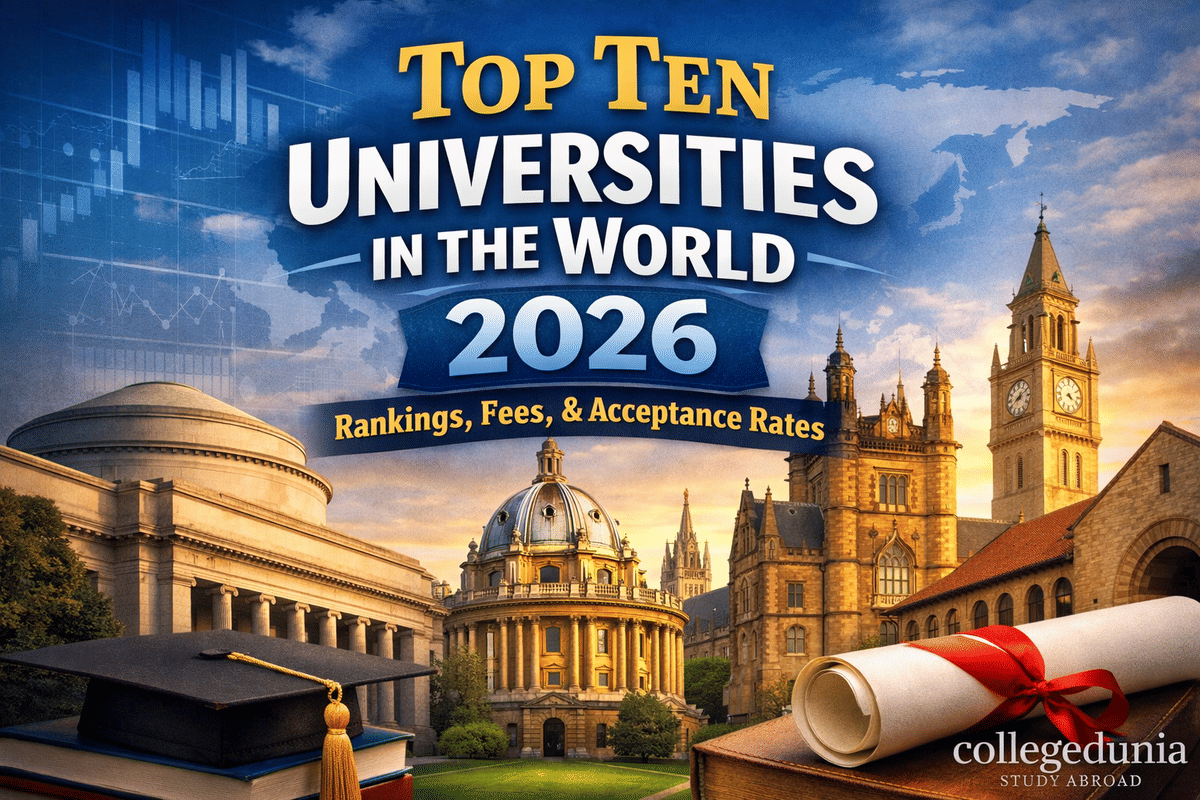
- Top Ten Universities in the World 2026
1.1 QS World University Rankings 2026 — Top 10
1.2 THE World University Rankings 2026 — Top 10
1.3 US News Best Global Universities 2025–2026 — Top 10
- How Are the World's Top Universities Ranked?
- Top 10 Universities in the World 2026 - Detailed Profiles
- Tuition Fees at the Top 10 Universities in the World 2026
4.1 Cost of Living by University City
4.2 Can Indian Students from Tier 3 Colleges Get In?
- FAQs
Top Ten Universities in the World 2026
The top 10 universities in the world in 2026 are dominated by institutions from the USA and UK, with Switzerland and Singapore also represented. Here is how the three major ranking bodies compare:
The three most trusted global university ranking systems — QS, THE, and US News — each use different methodologies, which is why their top 10 lists differ. Understanding these differences helps you choose the right benchmark for your goals.
Also Check: Top 10 Toughest Exams in the World
QS World University Rankings 2026 — Top 10
According to the QS World University Rankings 2026, published on June 19, 2025, the top 10 universities are:
| QS Rank | University | Country | QS Score |
|---|---|---|---|
| 1 | Massachusetts Institute of Technology (MIT) | USA | 100 |
| 2 | Imperial College London | UK | 99.4 |
| 3 | Stanford University | USA | 98.9 |
| 4 | University of Oxford | UK | 97.9 |
| 5 | Harvard University | USA | 97.7 |
| 6 | University of Cambridge | UK | 97.2 |
| 7 | ETH Zurich | Switzerland | 96.7 |
| 8 | National University of Singapore (NUS) | Singapore | 95.9 |
| 9 | UCL (University College London) | UK | 95.8 |
| 10 | California Institute of Technology (Caltech) | USA | 94.3 |
Source: QS World University Rankings 2026, topuniversities.com
THE World University Rankings 2026 — Top 10
According to the Times Higher Education (THE) World University Rankings 2026, Oxford leads for the 10th consecutive year:
| THE Rank | University | Country | THE Score |
|---|---|---|---|
| 1 | University of Oxford | UK | 98.2 |
| 2 | Massachusetts Institute of Technology (MIT) | USA | 97.7 |
| =3 | Princeton University | USA | 97.2 |
| =3 | University of Cambridge | UK | 97.2 |
| =5 | Harvard University | USA | 97.1 |
| =5 | Stanford University | USA | 97.1 |
| 7 | California Institute of Technology (Caltech) | USA | 96.3 |
| 8 | Imperial College London | UK | 94.7 |
| 9 | University of California, Berkeley | USA | 94.4 |
| 10 | Yale University | USA | 94.1 |
Source: THE World University Rankings 2026, timeshighereducation.com
US News Best Global Universities 2025–2026 — Top 10
According to US News Best Global Universities Rankings 2025–2026, Harvard leads the list:
| US News Rank | University | Country | Global Score |
|---|---|---|---|
| 1 | Harvard University | USA | 100.0 |
| 2 | Massachusetts Institute of Technology (MIT) | USA | 97.2 |
| 3 | Stanford University | USA | 94.5 |
| 4 | University of Oxford | UK | 88.3 |
| 5 | University of Cambridge | UK | 86.8 |
| 6 | University of California, Berkeley | USA | 86.4 |
| 7 | University College London (UCL) | UK | 86.2 |
| 8 | University of Washington | USA | 86.1 |
| 9 | Yale University | USA | 86.0 |
| 10 | Columbia University | USA | 85.8 |
Source: US News Best Global Universities Rankings 2025–2026, usnews.com
Key takeaway: MIT, Harvard, Stanford, Oxford, and Cambridge appear in all three top 10 lists — making them the most universally recognised elite universities in the world. If you're shortlisting universities, these five are your safest bets regardless of which ranking you follow.
How Are the World's Top Universities Ranked?
Rankings are not arbitrary, each system measures specific, weighted criteria. Understanding the methodology helps you pick the right ranking for your goals. A student focused on research output should weight QS and THE differently than one focused on employability.
QS Ranking Methodology and Key Indicators
According to the QS World University Rankings methodology, updated June 2025, universities are evaluated across these lenses:
| QS Indicator | Weighting | What It Measures |
|---|---|---|
| Academic Reputation | 30% | Peer recognition among 100,000+ academics globally |
| Citations per Faculty | 20% | Research impact and output intensity |
| Employer Reputation | 15% | Graduate employability as rated by 75,000+ employers |
| Faculty Student Ratio | 10% | Teaching quality and student support |
| International Faculty Ratio | 5% | Global diversity of academic staff |
| International Student Ratio | 5% | Campus diversity and global appeal |
| International Research Network | 5% | Cross-border research collaborations |
| Sustainability | 5% | Environmental, social, and governance (ESG) performance |
| Employment Outcomes | 5% | Graduate career success and alumni impact |
QS places the heaviest weight on academic and employer reputation (45% combined), making it particularly useful for students focused on career outcomes and global brand recognition.
THE Ranking Methodology and Key Indicators
According to the THE World University Rankings methodology, THE evaluates universities across five pillars using 18 performance indicators:
| THE Pillar | Weighting | Key Sub-indicators |
|---|---|---|
| Teaching (Learning Environment) | 29.5% | Teaching reputation, staff-to-student ratio, doctoral awards |
| Research Environment | 29% | Research reputation, income, productivity |
| Research Quality | 30% | Citation impact, research strength, research excellence |
| International Outlook | 7.5% | International students, staff, and collaboration |
| Industry Impact | 4% | Industry income and patents |
THE places the greatest weight on research quality and environment (59% combined), making it the gold standard for research-intensive institutions.
- For research and PhD programmes: Trust THE (research-heavy methodology)
- For career outcomes and employability: Trust QS (employer reputation is a key metric)
- For US-focused study: Trust US News (strongest coverage of American institutions)
- For overall global prestige: All three agree on the top 5 — MIT, Harvard, Stanford, Oxford, Cambridge
Note: Rankings can vary significantly by subject. A university ranked #15 overall may rank #3 in your specific field. Always check subject-specific rankings before finalising your shortlist.
Top 10 Universities in the World 2026 - Detailed Profiles
The top 10 universities in the world in 2026 span three continents and represent the pinnacle of academic excellence across research, teaching, and industry impact. Below are detailed profiles of each, with key data for Indian students.
1. Massachusetts Institute of Technology (MIT) — Cambridge, USA
QS Rank: #1 | THE Rank: #2 | US News Rank: #2
MIT has held the QS #1 position for 14 consecutive years, a record unmatched in global higher education. Located in Cambridge, Massachusetts, MIT is renowned for its dominance in STEM fields — science, technology, engineering, and mathematics.
MIT scores a perfect 100/100 in QS for Academic Reputation, Citations per Faculty, Faculty Student Ratio, and Employer Reputation — a near-impossible benchmark that no other university has matched.
- Notable alumni: Buzz Aldrin, Kofi Annan, Richard Feynman, Amar Bose
- Best for: Engineering, Computer Science, Physics, Economics, Architecture
- Acceptance rate: ~4% (undergraduate); graduate programmes vary by department
2. University of Oxford — Oxford, UK
QS Rank: #4 | THE Rank: #1 | US News Rank: #4
Oxford holds THE #1 position for the 10th consecutive year — a record in THE's history. Founded in 1096, it is the oldest English-speaking university in the world. Oxford's research environment score of 100/100 in THE reflects its unmatched depth of academic output across the humanities, sciences, and social sciences.
Oxford's tutorial system — where students receive one-on-one or small-group teaching from leading academics — is a key differentiator that no other top-10 university replicates at scale.
- Notable alumni: 28 UK Prime Ministers, Bill Clinton, Malala Yousafzai, J.R.R. Tolkien
- Best for: Law, PPE (Politics, Philosophy & Economics), Medicine, Humanities, Sciences
- Acceptance rate: ~15–17% overall; highly competitive for international applicants
Check out programs and fees at Oxford University
3. Stanford University — Stanford, USA
QS Rank: #3 | THE Rank: =5 | US News Rank: #3
Stanford sits at the heart of Silicon Valley, making it the world's most entrepreneurially connected university. According to Stanford's own data, Stanford alumni have founded companies including Google, HP, Netflix, and Instagram — generating an estimated $2.7 trillion in annual revenue. Stanford scores a perfect 100/100 in QS for Academic Reputation, Faculty Student Ratio, Employer Reputation, and Employment Outcomes.
- Notable alumni: Elon Musk, Larry Page, Sergey Brin, Reed Hastings
- Best for: Computer Science, Engineering, Business (MBA), Medicine, Law
- Acceptance rate: ~3.9% (undergraduate); highly selective at graduate level too
4. Harvard University — Cambridge, USA
QS Rank: #5 | THE Rank: =5 | US News Rank: #1
Harvard is the oldest university in the United States (founded 1636) and the #1 ranked university in the world according to US News. It leads in research output, with 161 Nobel laureates among its faculty and alumni. Harvard's endowment of over $50 billion is the largest of any university globally, enabling it to offer need-blind admissions to all international students.
- Notable alumni: Barack Obama, Mark Zuckerberg, Natalie Portman, Amartya Sen
- Best for: Law, Medicine, Business (MBA), Economics, Government, Sciences
- Acceptance rate: ~3.4% (undergraduate); among the most selective in the world
Check out courses at Harvard University
5. University of Cambridge — Cambridge, UK
QS Rank: #6 | THE Rank: =3 | US News Rank: #5
Cambridge is the second-oldest English-speaking university (founded 1209) and consistently ranks among the top 5 globally across all major ranking systems. Cambridge's collegiate system — 31 autonomous colleges — creates a uniquely intimate academic environment within a world-class research institution. According to THE, Cambridge scores 99.9/100 for Research Environment, reflecting its extraordinary depth of scientific output.
- Notable alumni: Isaac Newton, Charles Darwin, Stephen Hawking, Jawaharlal Nehru
- Best for: Natural Sciences, Mathematics, Engineering, Law, Economics
- Acceptance rate: ~17.5% overall; highly competitive for international students
Check out Cambridge courses and fees
6. Imperial College London — London, UK
QS Rank: #2 | THE Rank: #8 | US News Rank: Not in top 10
Imperial College London's rise to QS #2 is one of the most significant stories in the 2026 rankings. It scores a perfect 100/100 in QS for Employer Reputation, International Faculty Ratio, and International Student Diversity — reflecting its status as one of the most globally diverse and career-focused universities in the world. Located in South Kensington, London, Imperial focuses exclusively on science, engineering, medicine, and business.
- Notable alumni: H.G. Wells, Alexander Fleming, Brian May
- Best for: Engineering, Medicine, Computing, Business (MBA), Life Sciences
- Acceptance rate: ~14%
Check out courses available at Imperial College London
7. ETH Zurich — Zurich, Switzerland
QS Rank: #7 | THE Rank: #11 | US News Rank: Not in top 10
ETH Zurich is Europe's leading technical university and the only non-UK/US institution in the QS top 10. It scores 99.6/100 in QS for Sustainability — the highest of any top-10 university — and 98.8/100 for Citations per Faculty, reflecting exceptional research output. ETH Zurich has produced 22 Nobel laureates, including Albert Einstein (who studied there).
A critical advantage for Indian students: ETH Zurich charges minimal tuition fees — approximately CHF 730 (~₹69,000) per semester for all students, including internationals. This makes it one of the most affordable elite universities in the world.
- Notable alumni: Albert Einstein, John von Neumann, Wilhelm Röntgen
- Best for: Engineering, Computer Science, Physics, Architecture, Mathematics
- Acceptance rate: ~27% (but highly competitive for international applicants in STEM)
Check out courses offered at ETH Zurich
8. National University of Singapore (NUS) — Singapore
QS Rank: #8 | THE Rank: #17 | US News Rank: Not in top 10
NUS is Asia's highest-ranked university and the only Asian institution in the QS top 10. It scores a perfect 100/100 in QS for Employment Outcomes and International Faculty Ratio, reflecting its exceptional graduate employability and global academic community. Singapore's strategic location as Asia's financial and tech hub makes NUS graduates highly sought after across the Asia-Pacific region.
- Notable alumni: Tony Tan (former Singapore President), Ho Ching (CEO, Temasek Holdings)
- Best for: Computer Science, Engineering, Business, Law, Medicine
- Acceptance rate: ~10% for international students
9. UCL (University College London) — London, UK
QS Rank: #9 | THE Rank: #22 | US News Rank: #7
UCL was founded in 1826 as the first university in England to admit students regardless of religion or gender — a progressive legacy that continues today. UCL scores a perfect 100/100 in QS for International Student Ratio and International Student Diversity, making it the most internationally diverse university in the top 10. With over 44,000 students from 150+ countries, UCL's campus is a genuinely global community.
- Notable alumni: Mahatma Gandhi, Alexander Graham Bell, Ricky Gervais
- Best for: Law, Architecture, Economics, Computer Science, Medicine, Arts
- Acceptance rate: ~34% (one of the more accessible top-10 universities)
Check out UCL programs and fees
10. California Institute of Technology (Caltech) — Pasadena, USA
QS Rank: #10 | THE Rank: #7 | US News Rank: Not in top 10
Caltech is the smallest university in the top 10 — with just ~2,400 students — yet it punches far above its weight in research output. It scores a perfect 100/100 in QS for Citations per Faculty and Faculty Student Ratio, reflecting an extraordinary concentration of research talent. Caltech manages NASA's Jet Propulsion Laboratory and has produced 46 Nobel laureates — an astonishing ratio given its size.
- Notable alumni: Gordon Moore (Intel co-founder), Linus Pauling, Frank Malina
- Best for: Physics, Chemistry, Engineering, Computer Science, Biology
- Acceptance rate: ~3%
Check Out: Compare top universities in the USA for Indian students
Tuition Fees at the Top 10 Universities in the World 2026
Tuition fees at the world's top universities range from near-zero (ETH Zurich) to over ₹55 lakh per year (MIT, Harvard, Stanford). The good news: most of these universities offer substantial financial aid that can dramatically reduce the actual cost.
The table below shows annual tuition fees for international/graduate students. Note that undergraduate fees at US universities are often offset by need-based financial aid.
USD to INR conversion at 1 USD = ₹94.44, GBP to INR at approximately ₹119; SGD to INR at approximately ₹70.
| University | Annual Tuition (USD) | Annual Tuition (INR approx.) | Notes |
|---|---|---|---|
| MIT | ~$66,720 | ~₹63.0 lakh | Tuition-free for families earning <$200K/year (UG) |
| University of Oxford | ~£35,000–£45,000 | ~₹42–54 lakh | Varies by course; GBP rate ~₹119 |
| Stanford University | ~$65,127 | ~₹61.5 lakh | Need-blind admissions; strong financial aid |
| Harvard University | ~$59,320 | ~₹56.0 lakh | Free for families earning <$85K/year (UG) |
| University of Cambridge | ~£33,000–£64,000 | ~₹39–76 lakh | Varies significantly by course |
| Imperial College London | ~£37,000–£61,000 | ~₹44–73 lakh | Varies by programme |
| ETH Zurich | ~CHF 1,460/year | ~₹1.38 lakh | Extremely low fees for all students |
| NUS Singapore | ~SGD 17,550–37,650 | ~₹10.9–23.5 lakh | Subsidised rates available |
| UCL | ~£24,000–£38,000 | ~₹28.6–45.3 lakh | Varies by programme |
| Caltech | ~$63,255 | ~₹59.8 lakh | Strong financial aid available |
Cost of Living by University City
Tuition is only part of the picture. Living costs vary dramatically by city:
| City | University | Monthly Living Cost (USD) | Annual Living Cost (INR approx.) |
|---|---|---|---|
| Cambridge, USA | MIT, Harvard | 2,500–3,500 | ~₹28–39 lakh/year |
| Stanford, USA | Stanford | 2,200–3,200 | ~₹25–36 lakh/year |
| Oxford, UK | University of Oxford | 1,800–2,500 | ~₹20–28 lakh/year |
| Cambridge, UK | University of Cambridge | 1,800–2,500 | ~₹20–28 lakh/year |
| London, UK | Imperial, UCL | 2,200–3,000 | ~₹25–34 lakh/year |
| Zurich, Switzerland | ETH Zurich | 2,000–2,800 | ~₹22–31 lakh/year |
| Singapore | NUS | 1,200–1,800 | ~₹10–15 lakh/year |
| Pasadena, USA | Caltech | 2,000–2,800 | ~₹22–31 lakh/year |
Singapore offers the most affordable living costs among top-10 university cities, making NUS a particularly cost-effective option for Indian students.
Read More: Top Cities in USA for Indian Students
Can Indian Students from Tier 3 Colleges Get In?
This is one of the most common questions asked by Indian students — and the honest answer is: yes, but it requires exceptional compensating factors.
Top universities use holistic admissions. A student from a tier 3 college who has published research, built a strong portfolio, or demonstrated exceptional leadership can and does get admitted. However, the bar is higher. Here's what matters most:
- GPA: Minimum 3.5/4.0 for most top-10 universities; 3.8+ for MIT, Harvard, Stanford
- GRE/GMAT: 320+ GRE (for MS programmes); 720+ GMAT (for MBA)
- Research experience: Publications, conference papers, or significant research projects
- Statement of Purpose: Must clearly articulate your research goals and fit with the programme
- Letters of Recommendation: From professors or industry leaders who know your work deeply
- English proficiency: IELTS 7.0+ or TOEFL 100+ for most top-10 universities
The key insight: a strong research profile can compensate for a lower-ranked undergraduate institution. Many Indian students from tier 2 and tier 3 colleges have successfully gained admission to MIT, Stanford, and Cambridge by demonstrating exceptional research output or industry impact.
The top ten universities in the world in 2026 — MIT, Oxford, Stanford, Harvard, Cambridge, Imperial College London, ETH Zurich, NUS, UCL, and Caltech — represent the gold standard of global higher education. Each excels in different areas: MIT and Caltech lead in STEM research, Oxford and Cambridge in humanities and sciences, Harvard in law and medicine, Stanford in entrepreneurship and innovation, and NUS in Asia-Pacific career outcomes.
For Indian students, the key takeaways are:
- Rankings differ by methodology — use QS for employability, THE for research, US News for US-focused study
- Fees are high but financial aid is real — MIT, Harvard, and Stanford offer need-based aid that can cover most or all costs
- ETH Zurich and NUS are the most affordable top-10 options, with fees a fraction of US/UK alternatives
- Acceptance rates range from 3% to 34% — UCL and ETH Zurich are the most accessible
- IIT Bombay is rising (#118 globally in QS 2026) but top global universities still offer stronger international career platforms
Whether you're targeting a Master's in engineering at MIT, an MBA at Harvard, or a research PhD at Oxford, the path starts with building the right profile — strong academics, research experience, and a compelling application narrative.
FAQs
Ques. Which is the No. 1 university in the world in 2026?
Ans. It depends on the ranking system.
- According to QS World University Rankings 2026, MIT is #1 (score: 100/100).
- According to THE World University Rankings 2026, the University of Oxford is #1 (score: 98.2/100).
- According to US News Best Global Universities 2025–2026, Harvard University is #1 (score: 100/100).
MIT, Oxford, and Harvard are all considered the world's best universities — each excels in different areas.
Ques. What are the top 10 universities in the world according to QS 2026?
Ans. According to QS World University Rankings 2026, the top 10 are: 1. MIT, 2. Imperial College London, 3. Stanford University, 4. University of Oxford, 5. Harvard University, 6. University of Cambridge, 7. ETH Zurich, 8. NUS Singapore, 9. UCL, 10. Caltech. Published June 19, 2025.
Ques. Is Oxford or Harvard better in 2026?
Ans. Oxford ranks higher in THE 2026 (#1 vs Harvard's #5) and QS 2026 (#4 vs Harvard's #5). Harvard ranks higher in US News 2026 (#1 vs Oxford's #4). For research-intensive programmes, Oxford has a slight edge in THE rankings. For business and law, Harvard's brand recognition and alumni network are unmatched. The "better" university depends entirely on your field and career goals.
Ques. Which top university is best for engineering in 2026?
Ans. According to QS World University Rankings by Subject 2026, the top universities for engineering are: 1. MIT (USA), 2. Stanford University (USA), 3. ETH Zurich (Switzerland), 4. University of Oxford (UK), 5. Imperial College London (UK). For Indian students specifically, MIT, Stanford, and Imperial College London offer the strongest combination of research output, industry connections, and graduate employability in engineering.
Ques. Which top university is best for MBA in 2026?
Ans. For MBA programmes, the top universities in the world are Harvard Business School (Harvard University), Stanford Graduate School of Business (Stanford University), Wharton School of Business (University of Pennsylvania), MIT Sloan School of Management (MIT), and London Business School (affiliated with UCL's broader London ecosystem). Harvard and Stanford consistently rank #1 and #2 globally for MBA programmes across Financial Times, QS, and Bloomberg rankings.


1720429164.png?tr=w-305,h-145,c-force?h=40&w=40&mode=stretch)

1720436069.jpg?tr=w-305,h-145,c-force?h=40&w=40&mode=stretch)








Comments