



Education Journalist | Study Abroad Strategy Lead | Updated On - Mar 25, 2026
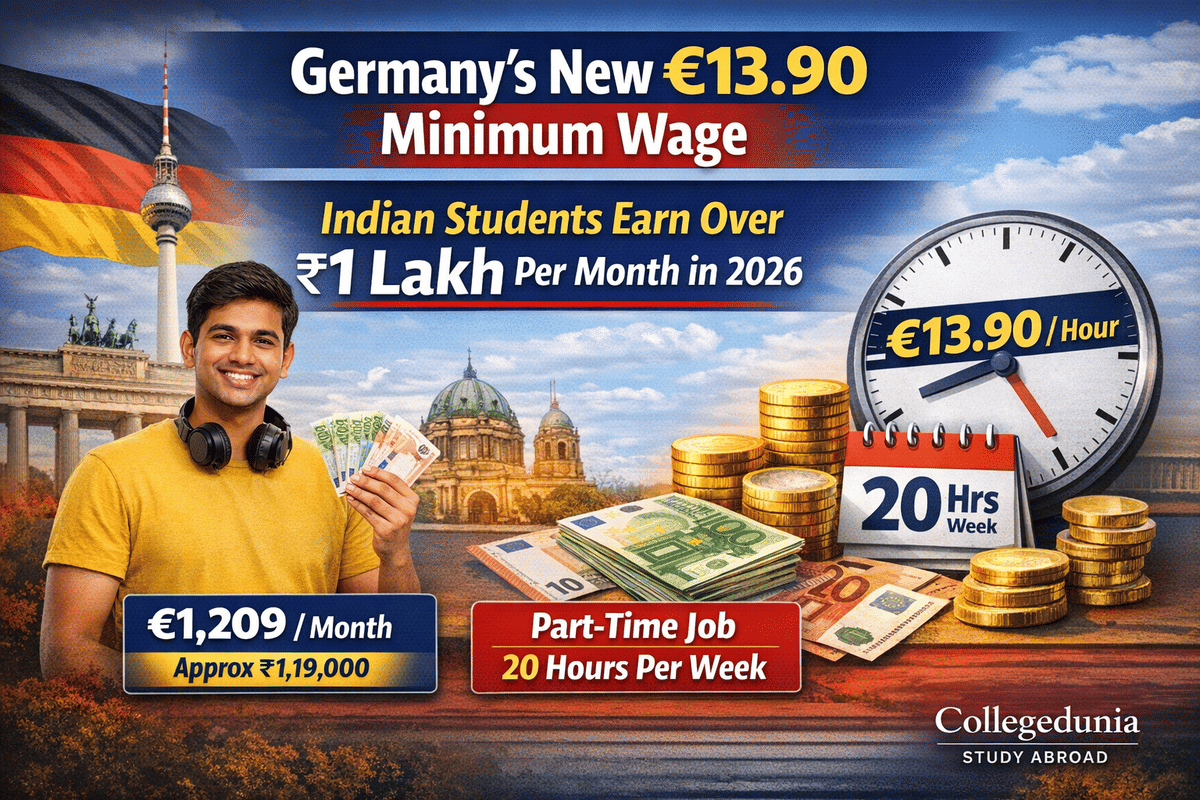
Indian students working part-time in Germany are taking home more money in 2026 than at any point in the country's history. For the first time, a student working 20 hours a week at minimum wage clears over ₹1 lakh per month. Germany raised its statutory minimum wage from €12.82 to €13.90 per hour on January 1, 2026 — an 8.4% increase — directly raising the floor income for the nearly 59,419 Indian students currently enrolled at German universities. A further rise to €14.60 is already confirmed for 2027.
What Changed on January 1, 2026
Germany's statutory minimum wage is set by the Mindestlohnkommission (Minimum Wage Commission) and applies to all workers — including international students on part-time contracts. The 2026 increase is the largest single-year jump since the minimum wage was introduced in 2015.
| Parameter | 2025 | 2026 | Change |
|---|---|---|---|
| Minimum wage (hourly) | €12.82 | €13.90 | +€1.08 (+8.4%) |
| Minijob monthly cap | €556 | €603 | +€47 |
| Minijob hours/month (at min. wage) | ~43 hrs | ~43 hrs | Unchanged |
| Next confirmed increase | — | €14.60 (2027) | +€0.70 |
Source: German Federal Government; studying-in-germany.org, January 2026
The Minijob cap increase is directly linked to the wage rise — it is calculated to allow approximately 43 hours of work per month at minimum wage while staying within the tax-free threshold.
Check part-time work options for Indian Students in Germany
The Three Ways Indian Students Work in Germany
Before the numbers, it helps to understand the three main work arrangements available to international students in Germany, because each has different tax and earnings implications.
1. Minijob (up to €603/month)
A Minijob is a low-hours, tax-free employment arrangement. You earn up to €603/month, pay no income tax, and can opt out of the 3.6% pension contribution. Your employer pays a flat 15% pension contribution on your behalf. This is the simplest, lowest-risk option — ideal for students who want a predictable, hassle-free income.
2. Werkstudent (working student contract, above €603/month)
A Werkstudent contract is for students working more hours — typically 20 hours/week during term. You are exempt from health, nursing care, and unemployment insurance contributions (a major benefit), but you do pay the 9.3% pension contribution. Income tax applies above the annual basic allowance of ~€11,604.
3. HiWi / Research Assistant (Hilfswissenschaftler)
University-based research or teaching assistant roles. Pay typically ranges from €13.90 to €17/hour. Treated as Werkstudent for tax purposes. Common for STEM and engineering Master's students.
What Indian Students Actually Earn: The Full Breakdown
All figures use the minimum wage of €13.90/hour and the ECB exchange rate of 1 EUR = ₹108.60 (March 24, 2026). Actual earnings vary by employer, role, and city.
Scenario 1: Minijob (43 hours/month, ~10–11 hrs/week)
| Parameter | EUR | INR (approx.) |
|---|---|---|
| Gross monthly income | €603 | ₹65,446 |
| Income tax | €0 | ₹0 |
| Pension contribution (opt-out available) | €0–€21.70 | ₹0–₹2,356 |
| Take-home (if opted out) | €603 | ₹65,446 |
A Minijob at minimum wage gives Indian students approximately ₹65,000/month with zero income tax deducted. This is the most common arrangement for first-year students or those in language/foundation programmes.
Scenario 2: Werkstudent at Minimum Wage (20 hrs/week, ~87 hrs/month)
| Parameter | EUR | INR (approx.) |
|---|---|---|
| Gross monthly income | €1,209 | ₹1,31,297 |
| Pension contribution (9.3%) | −€112 | −₹12,163 |
| Income tax (approx., within basic allowance) | ~€0–€30 | ~₹0–₹3,258 |
| Estimated take-home | ~€1,097–€1,097 | ~₹1,19,134 |
A Werkstudent working 20 hours/week at minimum wage earns approximately ₹1.19–₹1.21 lakh/month after pension deductions. Most students in this bracket stay within or close to the annual basic allowance (€11,604/year), meaning income tax is minimal or zero.
Scenario 3: Werkstudent at Above-Minimum Wage (20 hrs/week, typical STEM/IT roles)
Many Indian students in engineering, computer science, and data science programmes find Werkstudent roles paying €15–€18/hour — above the minimum wage floor.
| Hourly Rate | Gross/Month (87 hrs) | After Pension (9.3%) | In INR (approx.) |
|---|---|---|---|
| €13.90 (minimum) | €1,209 | ~€1,097 | ~₹1.19 lakh |
| €15.00 | €1,305 | ~€1,184 | ~₹1.28 lakh |
| €16.00 | €1,392 | ~€1,263 | ~₹1.37 lakh |
| €18.00 | €1,566 | ~€1,421 | ~₹1.54 lakh |
Note: Figures are approximate gross-to-net estimates. Actual take-home depends on tax class, health insurance type, and employer. Students should use a German net salary calculator (e.g., brutto-netto-rechner.info) for precise figures.
How Far Does This Go? City-by-City Coverage
Germany's cost of living varies significantly by city. Here is how a Werkstudent income at minimum wage (≈€1,097/month net) covers monthly student expenses across key cities.
| City | Avg. Monthly Student Cost | Werkstudent Net (€1,097) | Gap / Surplus |
|---|---|---|---|
| Leipzig / Halle | €750–€850 | €1,097 | +€247–€347 surplus |
| Dresden / Nuremberg | €800–€900 | €1,097 | +€197–€297 surplus |
| Berlin | €950–€1,100 | €1,097 | Roughly breaks even |
| Hamburg / Frankfurt | €1,000–€1,200 | €1,097 | −€103 to +€97 |
| Munich | €1,100–€1,400 | €1,097 | −€3 to −€303 deficit |
Cost of living data: studying-in-germany.org, 2026; mygermanuniversity.com, 2026
The takeaway: In most German cities outside Munich, a student working 20 hours/week at minimum wage can cover the majority — or all — of their monthly living costs. In Munich, a part-time income alone is typically not sufficient; students there often supplement with family remittances or scholarships.
Check the top cities in Germany for international students
What Changed vs. 2025 — The Before/After in Rupees
| Work Arrangement | Monthly Gross 2025 (€12.82/hr) | Monthly Gross 2026 (€13.90/hr) | Increase in INR |
|---|---|---|---|
| Minijob (43 hrs/month) | €551 (≈₹59,839) | €603 (≈₹65,446) | +₹5,607/month |
| Werkstudent 20 hrs/week | €1,115 (≈₹121,049) | €1,209 (≈₹1,31,297) | +₹10,248/month |
| Annual difference (Werkstudent) | — | — | +₹1.23 lakh/year |
Exchange rate: 1 EUR = ₹108.60 (ECB, March 24, 2026)
A Werkstudent working 20 hours/week earns approximately ₹1.23 lakh more per year in 2026 than in 2025 — purely from the minimum wage increase, before accounting for the expanded 140-day annual work cap introduced in March 2026.
The 2027 Increase Is Already Confirmed
Germany's minimum wage will rise again to €14.60/hour on January 1, 2027 — a further 5% increase. For Indian students planning a 2-year Master's programme starting in October 2026, this means:
- Year 1 (2026–27): Minimum wage €13.90/hr → Werkstudent gross ~€1,209/month
- Year 2 (2027–28): Minimum wage €14.60/hr → Werkstudent gross ~€1,270/month
Over a 2-year programme, a student working consistently at minimum wage (20 hrs/week) would earn approximately €29,000 gross — roughly ₹31.5 lakh at current exchange rates — before deductions.
What Indian Students Should Know Before Starting Work?
- Get your tax ID (Steuer-ID) immediately on arrival. You cannot be paid without it. Apply at your local Einwohnermeldeamt (registration office) when you register your address — it arrives by post within 2–4 weeks.
- Choose your contract type carefully. A Minijob is simpler and tax-free up to €603/month. A Werkstudent contract pays more but requires pension contributions. If you expect to earn above €603/month consistently, a Werkstudent contract is usually better value.
- Track your 140-day annual work limit. Since March 2026, international students can work up to 140 full days (or 280 half-days) per year. Exceeding this limit risks your visa status — use a tracking app to monitor your hours.
- File a tax return (Steuererklärung) at year end. Most students working part-time in Germany are entitled to a tax refund — particularly if they paid any wage tax during the year. The average student refund in Germany is €600–€900. Use apps like Taxfix or Wundertax for a straightforward filing process.
- Health insurance is separate. Student health insurance in Germany costs approximately €120–€130/month (public statutory insurance for students under 30). This is not deducted from your Werkstudent pay — it is a separate monthly payment you arrange independently.
















Comments