



Education Journalist | Study Abroad Strategy Lead | Updated On - Mar 24, 2026
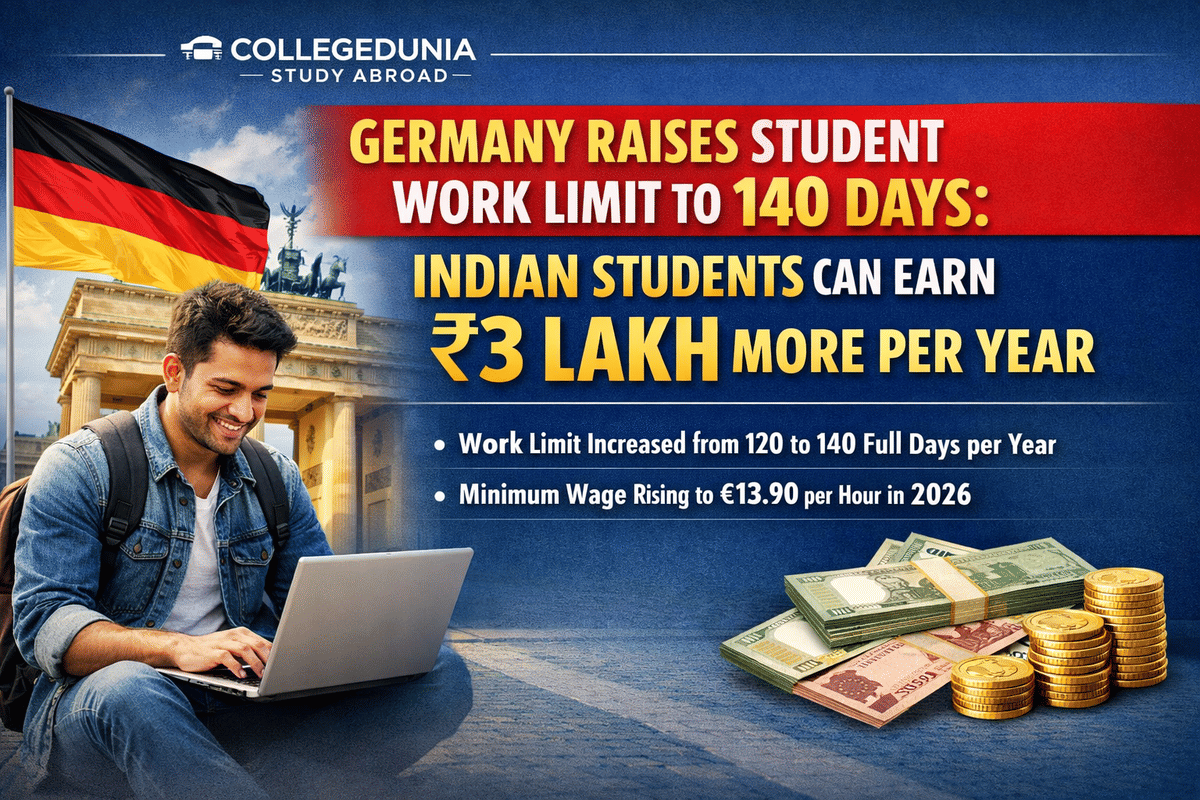
Indian students studying in Germany can now legally work 20 more days per year than before — and with Germany's minimum wage rising to €13.90 per hour in 2026, those extra days translate to up to ₹3.03 lakh in additional annual income. The expanded work allowance, introduced under Germany's Skilled Immigration Act and confirmed active for the 2026 summer semester, raises the annual cap for non-EU students from 120 to 140 full days (or 280 half-days) — a 16% increase that directly benefits the nearly 60,000 Indian students currently enrolled at German universities.
What Changed: From 120 to 140 Days
Under Section 16b of Germany's Residence Act, international students on a student visa have always been permitted to work part-time alongside their studies. The previous annual limit was 120 full days or 240 half-days per calendar year.
Germany's Skilled Immigration Act expanded this to 140 full days or 280 half-days per year — an increase of 20 full working days. The rule also allows students to work up to 20 hours per week as an alternative calculation method.
The change was confirmed active for the current summer semester 2026 by Germany's Federal Government portal, Make it in Germany, and reported by immigration services in March 2026.
Before vs. After:
| Rule | Previous | From 2026 |
|---|---|---|
| Annual full-day work limit | 120 days | 140 days |
| Annual half-day work limit | 240 half-days | 280 half-days |
| Weekly alternative | 20 hrs/week | 20 hrs/week (unchanged) |
| Minimum wage (hourly) | €12.82 (2025) | €13.90 (2026) |
| Max Minijob earnings/month | €556 (2025) | €603 (2026) |
What 20 Extra Days Mean in Rupees?
The income impact is significant — and it compounds with Germany's minimum wage increase, which rose from €12.82 to €13.90 per hour on January 1, 2026 (with a further rise to €14.60 confirmed for 2027).
At a standard 8-hour working day:
- 20 extra days × 8 hours = 160 additional hours per year
- At €13.90/hour: €2,224 gross in additional annual income
- At current exchange rates (1 EUR = ₹108.24 as of March 24, 2026): ≈ ₹2.41 lakh additional per year
For students working at rates above minimum wage — common in IT support, tutoring, and research assistant roles — the figure rises:
| Hourly Rate | Extra Income (20 days × 8 hrs) | In INR (approx.) |
|---|---|---|
| €13.90 (minimum wage) | €2,224 | ₹2.41 lakh |
| €15.00 (mid-range) | €2,400 | ₹2.60 lakh |
| €17.50 (tech/research) | €2,800 | ₹3.03 lakh |
For context: ₹2.41–₹3.03 lakh covers approximately 2–3 months of living costs in mid-sized German cities such as Stuttgart, Cologne, or Dresden, where average student monthly expenses run €800–€1,000 (≈ ₹86,000–₹1.08 lakh).
Who This Affects Among Indian Students in Germany?
India is now the largest source country for international students in Germany, with 59,419 Indian students enrolled as of the 2024/25 academic year — a 20% increase over the previous year, according to DAAD (German Academic Exchange Service) data. The vast majority are postgraduate students in STEM, engineering, and computer science programmes.
The 140-day rule applies to all students holding a residence permit under §16b of the Residence Act — which covers virtually all Indian students on a German student visa.
Who benefits most:
- Master's students in STEM and engineering — the largest Indian cohort in Germany, often working as research assistants or in IT support roles at above-minimum wage
- Students in their second year or beyond — who have established employer relationships and can plan their work calendar around the new limit
- Students in Minijob arrangements — the Minijob monthly cap also rose to €603 (from €556), allowing more hours within the tax-free threshold
- Students planning Blue Card applications post-graduation — more paid work hours means stronger employment history and professional references for Blue Card eligibility
Who is not affected:
- Students on a language course or Studienkolleg visa (preparatory programmes) — though the Skilled Immigration Act also extended part-time work rights to this group
- Students who already work fewer than 120 days per year — the change only matters if you were previously constrained by the cap
How to Track Your 140 Days — and Why It Matters
Exceeding the annual work limit is a visa compliance issue. German employers are required to report working hours, and the Ausländerbehörde (foreigners authority) can review your work record during residence permit renewals. Violations can jeopardise your student visa status.
Practical steps to stay compliant:
- Track every shift from January 1. The 140-day count resets each calendar year. A full day is any shift of more than 4 hours. A half-day is 4 hours or fewer.
- Use a tracking app. Apps such as Studo Worklog or Zeiterfassung Plus are widely used by international students in Germany to log shifts and monitor their annual tally.
- Clarify your contract type. If you work a Minijob (up to €603/month), the day-count rules still apply — Minijob status does not exempt you from the 140-day cap.
- Inform your employer. Some smaller employers — particularly in hospitality and retail — are unaware of the updated 140-day limit. Confirm in writing that your contract reflects the new allowance.
- Do not confuse the weekly and annual rules. You can work up to 20 hours per week OR up to 140 full days per year — these are alternative calculations, not cumulative. Choose the method that gives you more flexibility for your schedule.
The Bigger Picture: Germany's Talent Retention Strategy
The 140-day rule is one part of a broader set of changes Germany has made to attract and retain international student talent. The country faces a structural skilled labour shortage — the Federal Government warned in March 2026 of a 300,000-worker shortfall — and international students are a key pipeline.
Alongside the expanded work allowance, 2026 has brought:
- A minimum wage increase to €13.90/hour (January 2026), rising to €14.60 in 2027
- An 18-month post-study job-seeker permit allowing graduates to stay and find work without a job offer
- A faster APS certificate process (now 3–4 weeks digitally, down from 4–6 months) reducing the visa bottleneck for Indian applicants
- A temporary visa surge operation at Indian consulates processing student visas in as little as 6 days before Easter 2026
For Indian students weighing Germany against the US — where F-1 visa issuances to Indians fell 69% in summer 2025 — or the UK, where tuition costs continue to rise, the combination of near-zero tuition at most public universities, a structured post-study work pathway, and now a more generous part-time work allowance makes Germany's financial case stronger than it has ever been.
What Indian Students Should Do Now
- If you are already in Germany: Update your work calendar to reflect the 140-day limit from January 1, 2026. If you have been self-limiting to 120 days, you have 20 additional days available this calendar year.
- If you are applying for Winter Semester 2026/27: Factor the 140-day allowance into your financial planning. At minimum wage, 140 days of work (8 hrs/day) generates approximately €15,512 gross per year — enough to cover a significant portion of living costs in most German cities.
- If you are in a Minijob: Confirm your monthly earnings cap is updated to €603 with your employer. Some payroll systems may not have been updated automatically.
- If you are planning post-study work: Use the extra working days to build employer relationships and professional references — both are valuable for Blue Card applications, which require a qualifying job offer and salary threshold.

















Comments