



Education Journalist | Study Abroad Strategy Lead | Updated On - Mar 19, 2026
The United States has introduced a mandatory $250 (approximately ₹23,300) Visa Integrity Fee for all non-immigrant visa applicants — including Indian students applying for F1, J1, and M1 visas — under the One Big Beautiful Bill Act (OBBBA), signed by President Trump on July 4, 2025. The fee took effect from October 1, 2025, and applies to every visa approved at a US embassy or consulate worldwide.
For Indian students already navigating high tuition costs, SEVIS fees, and MRV application charges, this addition pushes the total upfront visa cost to over ₹40,000 — before a single rupee is spent on flights or accommodation. With over 363,000 Indian students enrolled in US universities in 2024–25, and tens of thousands more applying for Fall 2026, the financial impact is immediate and widespread.
Check the types of US Student Visa for Indian Students
What the $250 Visa Integrity Fee Actually Is?
The Visa Integrity Fee is a new charge introduced under H.R.1 — the One Big Beautiful Bill Act — to address visa overstays. According to the US Department of Homeland Security (DHS), approximately 565,155 foreign nationals overstayed their visas in FY 2023 alone. The fee is designed as a financial incentive: applicants who comply fully with their visa terms may be eligible for a reimbursement after their visa expires.
Key facts:
- Amount: 250 for FY2025 (October 1, 2025 – September 30, 2026)
- Collected by: US Department of Homeland Security (DHS) — separate from the MRV fee collected by the Department of State
- Applies to: All non-immigrant visa approvals at US embassies and consulates globally
- Does NOT apply to: Visa refusals/denials; Canadian nationals; nationals of Visa Waiver Programme (VWP) countries using ESTA
- No fee waiver available — the fee is mandatory for all eligible applicants
How Much Will an Indian Student Pay in Total?
At the current exchange rate of approximately ₹93 per USD (as of March 19, 2026; source: Federal Reserve / x-rates.com), here is what Indian students now face in upfront visa costs:
| Visa Type | MRV Fee (USD) | Visa Integrity Fee (USD) | Total (USD) | Total (INR approx.) |
| F1 (Student) | $185 | $250 | $435 | ~₹40,455 |
| J1 (Exchange Visitor) | $185 | $250 | $435 | ~₹40,455 |
| M1 (Vocational Student) | $185 | $250 | $435 | ~₹40,455 |
| B1/B2 (Visitor/Parents) | $185 | $250 | $435 | ~₹40,455 |
| H1B / L1 (Work) | $205 | $250 | $455 | ~₹42,315 |
Note: SEVIS fee (350 for F1/M1; 220 for J1) is additional and not included above.
Exchange rate: 1 USD = ₹93 (March 19, 2026).
Before the OBBBA, an F1 applicant paid USD 185 (MRV) + 350 (SEVIS) = 535 (₹49,755).
Post−OBBBA, the same applicant now pays USD 785 (~₹73,005) — a 47% increase in total upfront visa costs.
Why This Matters for Indian Students?
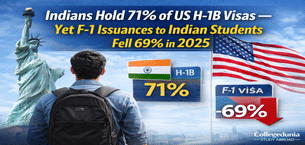
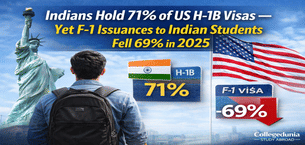
India remains the single largest source of international students in the United States, with 363,019 students enrolled in 2024–25 — up from 331,602 the previous year, according to the Institute of International Education's Open Doors report. Yet F1 visa issuances to Indian students have already dropped sharply: data from the US State Department shows only 12,776 F1 visas were issued to Indians in June–July 2025, compared to 41,336 in the same period in 2024 — a 69% decline.
- The Visa Integrity Fee adds another layer of financial friction at a time when Indian students are already reconsidering the US as a destination.
- Countries like Canada, Germany, and Australia are actively streamlining their visa processes, while the US is adding costs and complexity.
The fee's name has also drawn criticism. Experts note that framing a mandatory charge as an "integrity" fee implicitly signals distrust toward applicants — a perception issue that could further dent the US's appeal among aspirational Indian students.
Who Is Affected?
- Fall 2026 F1/J1/M1 applicants — anyone applying for a US student visa from October 2025 onward pays the fee
- Undergraduate and postgraduate students — no exemption by degree level
- STEM and non-STEM applicants — applies equally across all disciplines
- MBA applicants — included under F1 category
- Dependent visa holders — F2, H4, L2, and other dependent non-immigrant visa holders are also subject to the fee
- Parents applying for B1/B2 visitor visas — a family of four applying for US visitor visas now pays an additional ₹93,200 in Integrity Fees alone
Who is NOT affected:
- Students from Visa Waiver Programme countries (e.g., UK, Germany, Japan)
- Canadian nationals
- Applicants whose visa is refused or denied (fee applies only on approval)
Can You Get the $250 Back?
Technically, yes — but with significant conditions. The OBBBA states that DHS "may provide a reimbursement" (discretionary language) after the visa expires, provided the holder:
- Complied with all visa conditions and did not accept unauthorised employment
- Did not overstay — departed the US within 5 days of the I-94 expiry date
- Did not request an extension of their period of admission (unless they obtained an H1B extension, green card, or adjustment of status)
Critical caveat for F1 students: Most F1 visas are issued for 5 years (or the duration of the programme). The reimbursement would only be processed after the visa expires — meaning students may wait years before seeing any refund. The exact refund mechanism has not yet been published by DHS, and no Federal Register notice on the process has been issued as of March 2026.
Bottom line: Treat the $250 as a non-refundable cost when budgeting.
What Indian Students Should Do Now?
- Budget for the full cost upfront. Add $250 (~₹23,300) to your US visa cost estimate. For F1 applicants, total upfront visa costs are now approximately ₹73,000 (MRV + SEVIS + Integrity Fee).
- Apply early for Fall 2026. US visa appointment slots in India have historically faced long wait times. Factor in the new fee when planning your application timeline.
- Do not assume a refund. DHS has not published the refund mechanism. Plan your finances without counting on the $250 coming back.
- Compare total cost of study abroad. With US visa costs rising, compare the full cost of studying in the UK, Canada, Germany, or Australia — some of which have lower or no equivalent integrity fees.
- Check if your visa category is exempt. If you hold citizenship or residency in a VWP country, you may not be subject to this fee. Confirm with your visa consultant.
- Keep all payment receipts. When the refund process is eventually published, you will need documentation of your original payment.











Comments