



Education Journalist | Study Abroad Strategy Lead | Updated On - Mar 20, 2026
US consulates across India are currently showing shorter F1, J1, and M1 student visa appointment wait times than at any point in the past year — with New Delhi now offering next available slots in under two weeks. The window is real, but it is narrow. As tens of thousands of Indian students prepare to apply for Fall 2026, appointment availability will tighten sharply between April and July, when peak demand hits.
According to the US State Department's Global Visa Wait Times portal (last updated February 13, 2026), New Delhi's F/M/J visa queue has dropped to under 0.5 months — a dramatic improvement from the two-month wait recorded in December 2025. Students who book now are likely to secure interviews well before the summer backlog sets in.
Check: US Student Visa Requirements for Indian Students
What the Current Wait Times Show Across Indian Cities
The US State Department updates its Global Visa Wait Times portal monthly. The February 2026 data — the most recent available — shows a clear split between consulates, with New Delhi leading the improvement and Mumbai still carrying a significant backlog.
F/M/J Visa (Student) — Next Available Appointment, India (February 2026):
| Consulate | F/M/J Next Available | Change from Dec 2025 |
|---|---|---|
| New Delhi | < 0.5 months (~2 weeks) | Improved from 0.5 months |
| Chennai | 1 month | Improved from 2 months |
| Hyderabad | 2.5 months | Stable |
| Kolkata | 2 months | Improved from 2.5 months |
| Mumbai | 2.5 months | Stable |
Source: US State Department Global Visa Wait Times portal, last updated February 13, 2026. travel.state.gov
New Delhi is the standout. A sub-two-week wait for student visa interviews is exceptionally short by historical standards — and it will not last once the April–July application surge begins. Chennai has also improved meaningfully, dropping from a two-month wait to one month.
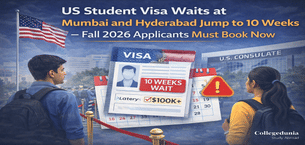
Mumbai and Hyderabad remain at 2.5 months, which is manageable for Fall 2026 if students apply in March or April, but becomes risky if delayed to May or June.
Check: Top US Universities for Indian Students
Why Slots Are Freer Right Now?
The current easing reflects a combination of factors specific to this point in the academic calendar:
- Lower demand in the off-peak window. The bulk of Fall 2026 applicants — those who received I-20s in January and February — are still completing their DS-160 forms, paying SEVIS fees, and gathering documents. Most have not yet booked appointments. This creates a brief window of lower competition for slots.
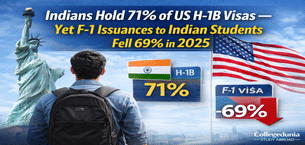
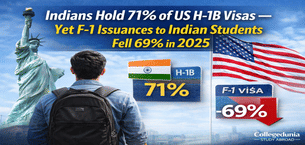
- Backlog clearance from the 2025 cycle. US consulates in India processed a significantly reduced volume of F1 visas in summer 2025 — issuances to Indian students fell 69% in June–July 2025 compared to the same period in 2024, according to US State Department data. With fewer carry-over cases, consulates enter 2026 with lighter queues.
- Consular capacity has not been reduced. Despite broader immigration policy changes under the current US administration, consular interview capacity at Indian posts has remained stable. The State Department continues to release new appointment slots regularly.
The combination of lower current demand and stable capacity creates a temporary advantage — one that typically closes by late April as the pre-Fall rush accelerates.
Why This Matters for Indian Students Applying for Fall 2026?
For Indian students targeting a Fall 2026 start, the visa interview timeline is one of the most consequential decisions in the application process. Most US universities require students to arrive by mid-to-late August. Working backward:
- Visa interview: Should ideally happen by June at the latest
- Post-interview processing: Typically 3–5 business days for standard cases; longer if administrative processing is triggered
- DS-160 + SEVIS fee payment: Must be completed before booking an appointment
- I-20 receipt: Required before any of the above
A student in New Delhi who books an appointment today could have their interview done by early April — giving them a four-month buffer before the August arrival window. A student who waits until May to book in Mumbai faces a 2.5-month queue, pushing their interview to late July — dangerously close to programme start dates.
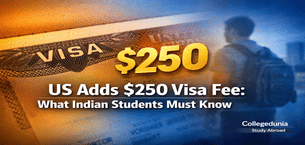
The stakes are higher this year because of the new $250 Visa Integrity Fee (effective October 1, 2025), which adds to the financial pressure of the application. Students who are rejected or face delays cannot easily reschedule without incurring additional costs.
Who Should Act Immediately
- Fall 2026 UG and PG applicants who have received their I-20 and are ready to pay the SEVIS fee
- MBA applicants with Round 2 or Round 3 admits targeting August 2026 starts
- STEM MS/PhD applicants — particularly those at Hyderabad and Mumbai, where queues are longer
- Students applying from Mumbai or Hyderabad — the 2.5-month wait means a March booking leads to a late-May/early-June interview; a May booking pushes to late July
- First-time F1 applicants — dropbox (interview waiver) is not available for first-time applicants, making early booking even more critical
What Students Should Do Right Now
- Confirm your I-20 is finalised and SEVIS fee is paid. You cannot book a visa appointment without a valid SEVIS receipt (Form I-901). Pay at fmjfee.com.
- Complete your DS-160 form. The DS-160 is the online nonimmigrant visa application. Complete it at ceac.state.gov. Save your application ID — you will need it to book your appointment.
- Book your appointment immediately at ustraveldocs.com. Log in, select your consulate, and choose the earliest available F/M/J slot. New Delhi applicants should check daily — slots at this level of availability can fill within days once word spreads.
- Choose your consulate strategically. You are not required to apply at the consulate nearest to your home. If New Delhi or Chennai has a significantly shorter wait, and you can travel there, it may be worth it. Confirm the consulate's current wait time before booking.
- Prepare your documents in parallel. Do not wait until after booking to gather documents. Start now: I-20, SEVIS receipt, DS-160 confirmation, financial proof, admission letter, academic transcripts, and passport valid for at least six months beyond your intended stay.
- Set a calendar reminder to check for earlier slots. Consulates release new appointment slots regularly. If you book a slot that is further out than you'd like, check back every few days — earlier slots often open up due to cancellations.
- Do not delay past April. Historical data shows that F1 appointment availability in India tightens sharply from late April onward. Students who book in March or early April consistently secure better interview dates than those who wait.









Comments