



Education Journalist | Study Abroad Strategy Lead | Updated On - Mar 30, 2026
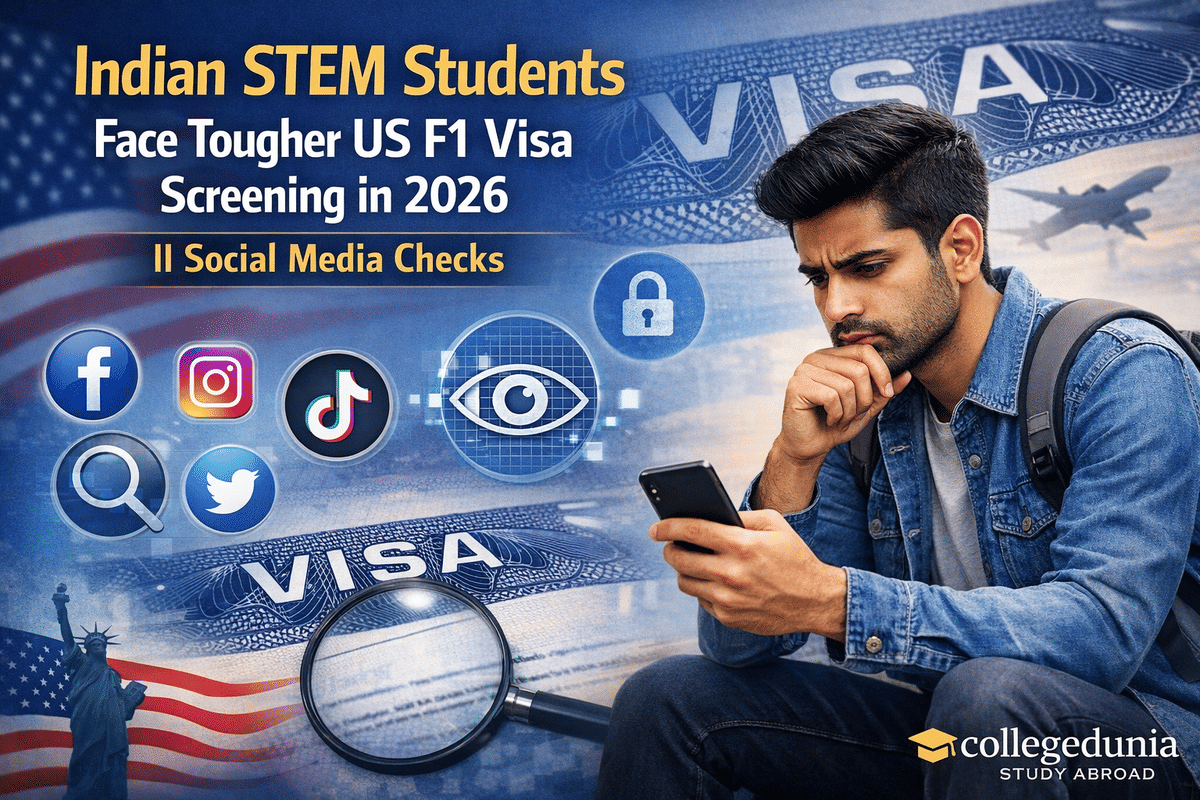
Indian STEM students applying for US F-1 visas in 2026 face a vetting layer that did not exist two years ago. Consular officers now review GitHub repositories, LinkedIn profiles, and four other platforms as part of mandatory social media screening for every F, M, and J visa applicant. Since the US State Department made this vetting universal on June 18, 2025, 221(g) administrative processing holds — which can delay visa issuance by 4–6 months — have surged sharply at Indian consulates, with STEM applicants in fields on the Technology Alert List (TAL) facing the longest delays.
Indians account for 27% of all international students in the US and are disproportionately concentrated in the exact STEM fields — AI, machine learning, advanced computing, biotechnology, information security — that appear on the TAL. A GitHub repository with dual-use research keywords, a LinkedIn headline describing TAL-adjacent work, or a public post flagged during the 5-year review window can trigger an AP hold that pushes a Fall 2026 start date to December or beyond.
Check out top universities in US for Indian Students in 2026
What Changed on June 18, 2025 — and Why STEM Students Are Most Exposed
Before June 2025, social media screening was selective — applied primarily to applicants already flagged for security concerns. The US State Department's June 18, 2025 announcement changed this permanently: "We will conduct a comprehensive and thorough vetting, including online presence, of all student and exchange visitor applicants in the F, M, and J nonimmigrant classifications."
All applicants must now:
- Set all social media profiles to "public" before their interview
- List every social media username or handle used in the last 5 years on the DS-160 form
- Understand that omitting any platform constitutes a false certification and can result in permanent visa ineligibility
The shift from selective to universal screening is the structural change. But for STEM students, a second layer compounds the risk: the Technology Alert List (TAL), a set of guidelines used by consular officers to identify applicants whose academic or research work involves fields with potential military applications. TAL-flagged applications are referred for a Visa Mantis security check — an interagency review that routinely takes 4–6 months and has no guaranteed resolution timeline.
- Before June 2025: Social media reviewed only for flagged applicants. TAL checks triggered by DS-160 field-of-study declarations.
- From June 2025: Social media reviewed for all F/M/J applicants. TAL checks now also triggered by what officers find in public GitHub repositories, LinkedIn research descriptions, and academic publication profiles — not just the DS-160.
The Technology Alert List: Which Indian STEM Fields Are at Risk
The TAL covers 13 broad technology categories. The following are the most directly relevant to Indian STEM students applying for MS and PhD programmes in 2026:
| TAL Category | Specific Sub-fields Most Relevant to Indian STEM Applicants |
|---|---|
| Advanced Computer / Microelectronic Technology | AI, machine learning, neural networks, supercomputing, data fusion, quantum computing |
| Information Security | Cryptography, cybersecurity, encryption systems, network security |
| Robotics | Artificial intelligence, automation, pattern recognition, computer-controlled systems |
| Chemical, Biotechnology & Biomedical Engineering | Genetic engineering, recombinant DNA, virology, immunology, biochemistry, pharmacology |
| Remote Sensing, Imaging & Reconnaissance | Satellite imaging, drone technology, UAV systems, high-resolution optical systems |
| Rocket Systems & UAV | Aerospace propulsion, guidance systems, navigation, avionics |
| Materials Technology | Advanced composites, nanomaterials, superconductors, magnetic materials |
| Sensors & Sensor Technology | Optical sensors, night vision, magnetometers, high-speed imaging |
The critical point for Indian students: These are not obscure fields. AI, machine learning, cybersecurity, biotechnology, and advanced computing are the most popular MS and PhD specialisations among Indian applicants to US universities. A student applying for an MS in Computer Science in US with a machine learning focus, or a PhD in Biomedical Engineering, is applying in a TAL-adjacent field by definition.
Why GitHub and LinkedIn Are Now the Highest-Risk Platforms for STEM Applicants?
Most Indian students understand that Instagram posts or X (Twitter) activity can be reviewed. Fewer understand that GitHub and LinkedIn carry a distinct, higher-order risk for STEM applicants — because they contain research-specific content that maps directly to TAL categories.
GitHub: What officers are looking for
A GitHub profile is a public record of a student's technical work. For a STEM applicant, it may contain:
- Repository names and descriptions that use TAL-flagged keywords (e.g., "autonomous drone navigation," "cryptographic key generation," "neural network for target detection," "bioweapon detection algorithm")
- README files describing research methodology in dual-use fields
- Commit histories showing sustained work on sensitive technology areas
- Contributions to open-source projects with defence or intelligence applications
A repository named "UAV-path-planning" or "adversarial-ML-attack-detection" is not inherently problematic — but it will be reviewed by an officer who is trained to flag TAL-adjacent keywords. The officer does not need to determine that the work is harmful; they only need to determine that it could fall within TAL purview to refer the application for a Visa Mantis check.
LinkedIn: What officers are looking for
LinkedIn is the professional identity layer. For STEM applicants, the risk areas are:
- Headline and summary — descriptions like "AI researcher specialising in autonomous systems" or "cybersecurity engineer with cryptography focus" directly map to TAL categories
- Experience section — prior work at defence contractors, government agencies, or dual-use technology companies
- Publications and projects — listed research papers or projects with TAL-adjacent titles
- Connections and endorsements — affiliations with organisations or individuals flagged in other security contexts (this is a secondary risk, but documented in immigration attorney guidance)
The Kaushik Raj case
Kaushik Raj, an Indian journalist, was denied a US F-1 visa despite a $100,000 (₹89 lakh) scholarship to Columbia University's MS in Data Journalism programme. His visa interview was on July 29, 2025. Officers asked him to make his social media public. His application moved to "refused" on August 4, then to "administrative processing" on August 11, then back to "refused" on August 14.
His rejection letter stated: "You were not able to demonstrate that your intended activities in the United States would be consistent with the classification of the nonimmigrant visa for which you applied."
Raj told Hindustan Times: "I track hate crimes. I combine the trends on social media and its impact on the ground, especially those against minorities. A lot of my friends said that they might have thought that I would do the same in the US."
His case illustrates the core risk: content that is entirely legitimate in a journalistic or academic context can be misread by automated or manual screening as inconsistent with stated study intent.
Platform-by-Platform Audit Checklist for Indian STEM Applicants
Complete this audit before booking your F-1 visa interview. Do not delete content — deletion itself raises flags. Instead, review, contextualise, and where necessary, consult an immigration attorney.
GitHub
- Review all public repository names and descriptions for TAL-adjacent keywords
- Check README files for dual-use language (e.g., "weapon," "attack," "surveillance," "exploit," "intercept")
- Ensure your profile bio and pinned repositories accurately reflect your academic purpose
- If a repository could be misread as defence-related, add a clear academic context statement to the README
- Do NOT make repositories private immediately before your interview — this pattern is flagged
- Do NOT delete commit history — this is also flagged
- Review your headline: does it use TAL-adjacent language without academic context?
- Review your experience section: does any prior employer have defence, intelligence, or dual-use technology associations?
- Review listed publications and projects: do any titles map to TAL categories?
- Ensure your stated purpose (studying in the US) is consistent with your profile narrative
- Do NOT set your profile to private before your interview — the DS-160 requires you to list it, and a private profile after listing it is a red flag
Instagram / X (Twitter) / Facebook
- Review the last 5 years of posts for content that could be read as: hostile to the US, supportive of designated terrorist organisations, or inconsistent with your stated study purpose
- Check tagged posts and shared content — not just your own posts
- Ensure your stated nationality, location history, and identity are consistent across platforms
- Do NOT delete posts — document them and consult an attorney if concerned about specific content
- Do NOT create new accounts or change usernames shortly before your interview
DS-160 Form
- List every platform you have used in the last 5 years — including platforms you no longer actively use
- Ensure your listed usernames match what officers will find when they search
- If you have changed usernames, list both the old and new handles
What to Do If You Are in a TAL-Adjacent Field?
If your MS or PhD programme falls in AI, machine learning, cybersecurity, biotechnology, advanced materials, aerospace, or any other TAL category, treat administrative processing as a planning assumption — not an edge case.
Practical steps:
- Apply for your visa at least 6 months before your programme start date. For Fall 2026 (August start), this means applying by February–March 2026. If you have not yet applied, book your interview immediately — New Delhi and Chennai currently have shorter queues than Mumbai and Hyderabad.
- Do not book non-refundable flights or accommodation until your visa is physically in hand. AP holds have pushed Fall 2026 start dates to October–December 2026 for some STEM applicants.
- Contact your university's international student office about deferred enrolment options before your interview, not after an AP hold is issued.
- Prepare a clear, written explanation of your research that contextualises any TAL-adjacent work in academic terms. This is not required at the interview, but having it ready helps if you receive a 221(g) notice requesting additional documentation.
- If you receive a 221(g) notice: Check your CEAC status at ceac.state.gov regularly. If no documents were requested, monitor for 60 days before seeking legal advice. After 180 days with no resolution, consult an immigration attorney.
The US State Department's June 2025 announcement was not a temporary measure. Immigration attorneys and university advisors across the US are now treating extended AP timelines as a baseline planning assumption for STEM applicants. The combination of universal social media vetting and the Technology Alert List has created a new, permanent layer of scrutiny that did not exist before 2025.
For Indian students — who make up 27% of all international students in the US and are disproportionately concentrated in TAL-adjacent STEM fields — this is not an abstract policy shift. It is a concrete change to the visa process that requires a concrete change in preparation. The students who understand what officers are looking for on GitHub and LinkedIn, and who audit their profiles before their interview, are in a materially better position than those who do not.










Comments