




Johns Hopkins University (JHU) is a private university in the USA. The international student cohort at JHU is around 27%. The university offers admission in the following intakes:
- Summer (May)
- Spring (Jan)
- Fall (Primary intake, August)
Application Deadlines for applying to Johns Hopkins University:
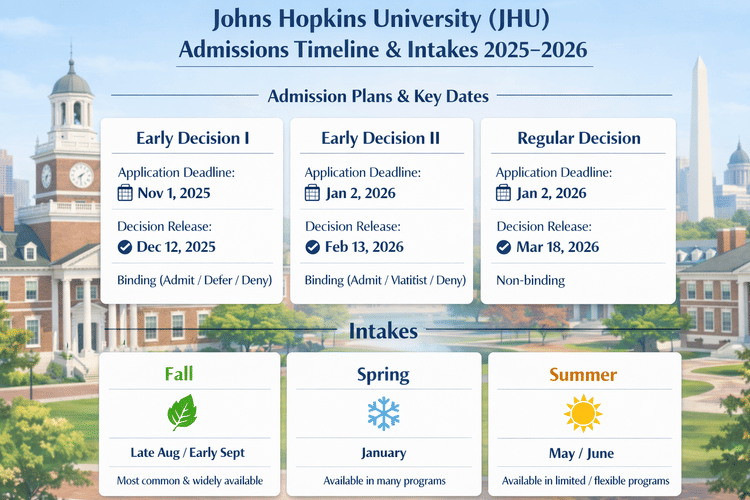
- November 1, 2025 (Early Decision I)
- January 2, 2026 (Early Decision II)
- January 2, 2026 (Regular Decision)
The three types of decisions allow students with different priorities to align with the university deadlines. According to the Common Data Set, JHU's overall acceptance rate is 6.4%. For international students, the acceptance rate is around 4.5%.
The Baltimore campuses of Johns Hopkins are the primary ones. Thus, most students follow the application process for those respective schools. The students can apply for undergraduate courses via the Common Application. For the graduate courses, students need to apply via the university portal.
The overall requirements to apply for Johns Hopkins University include:
- English Test Scores requirement: TOEFL: ~100+ | IELTS: ~7.0+
- Transcript Evaluation: Submit scanned images via the application form for UG | Get it done from an NACES member (Recommended)
- Standardized tests: SAT/ACT scores are mandatory from Fall 2026 for UG | GRE/GMAT scores for certain PG programs (optional)
- Johns Hopkins University Application Portal
- The Johns Hopkins University Intakes
- JHU Decision and Deadlines
- The Johns Hopkins University Popular Courses and Duration
-
- English Test Scores Requirement at JHU
- Johns Hopkins University Admission Process
- What is the Acceptance Rate at Johns Hopkins University
- FAQs
Johns Hopkins University Application Portal
The official portal for applying to Johns Hopkins University as a bachelor’s or master’s applicant is as follows:
| Program Level | Application Portal |
|---|---|
| Bachelor’s (Undergraduate) | Common Application or Coalition on Scoir |
| Master’s (Graduate) | Johns Hopkins Graduate Application Portal |
The Johns Hopkins University Intakes
The university offers admission in three intakes: Summer, Spring, and Fall. Students can check for the course availability in a particular intake and apply accordingly.
| Intake | Typical Start Month | Availability |
|---|---|---|
| Fall | Late August / Early September | Most common & widely available |
| Spring | January | Available in many programs |
| Summer | May / June | Available in some flexible programs |
Fall is the primary and the only intake for undergraduate applicants. For master’s applicants, it depends on the school/division. Some schools are flexible with the intakes, while some are not.
Note: Check the school in which the chosen course is taught, check the availability of intakes, and apply accordingly.
JHU Decision and Deadlines
The students can choose the admission decision as:
- Early Decision I (ED I): The student is either admitted, deferred to Regular Decision, or denied. The application decision is given by mid-December for ED I.
- Early Decision II (ED II): The student can be admitted, waitlisted, or denied. The application decision is received by mid-February in this case.
- Regular Decision (RD): It is the standard decision timeline. It is non-binding. Good for students who need time and more flexibility to apply to JHU.
ED I and ED II follow a binding agreement which states that the student will enroll at Johns Hopkins University if admitted and withdraw any other applications to other schools.
According to the university, the deadlines are as follows:
| Deadlines | Early Decision I | Early Decision II | Regular Decision |
|---|---|---|---|
| Application Deadline | November 1, 2025 | January 2, 2026 | January 2, 2026 |
| Financial Aid Deadline | November 15, 2025 | January 15, 2026 | January 15, 2026 |
| Decision Release | December 12, 2025 | February 13, 2026 | March 18, 2026 |
| Reply-By Date | January 15, 2026 | February 27, 2026 | May 1, 2026 |
The Johns Hopkins University Popular Courses and Duration
The Johns Hopkins University offers popular programs in various of its schools that are spread across its 9 campuses globally. The major schools are present in the Homewood campus of the city of Baltimore, Maryland. The Homewood campus is home to almost all the undergraduate courses taught at Johns Hopkins University.
While the availability of master’s programs varies by the schools and campuses, most are available in the schools of the Baltimore campuses. Below is the list of popular programs at Johns Hopkins University across its schools:
| Program | Duration | Annual Tuition Fees | School |
|---|---|---|---|
| MS Biotechnology (STEM) | 12–36 months |
$57,400- $58,400 (₹53.8-₹54.7 Lakhs) |
Advanced Academic Programs (AAP), Krieger School of Arts & Sciences |
| MS Computer Science (STEM) | 18–24 months |
$66,670 (₹62.5 Lakhs) |
Whiting School of Engineering |
| MS Applied Economics (STEM) | 12–24 months |
$55,550- $56,550 (₹52.1- ₹53 Lakhs) |
Advanced Academic Programs (AAP), Krieger School of Arts & Sciences |
| MS Finance | 9–15 months |
$58,000–$72,000 (₹54.4- ₹67.5 Lakhs) |
Carey Business School |
| Master of Public Health (MPH) | 11 months |
$87,480 (₹82 Lakhs) |
Bloomberg School of Public Health |
| BA Psychology | 4 years |
$66,670 (₹62.5 Lakhs) |
Krieger School of Arts & Sciences |
| BS Computer Engineering (STEM) | 4 years |
$66,670 (₹62.5 Lakhs) |
Whiting School of Engineering |
| BA Film and Media Studies | 4 years |
$66,670 (₹62.5 Lakhs) |
Krieger School of Arts & Sciences |
| BS Biophysics (STEM) | 4 years |
$66,670 (₹62.5 Lakhs) |
Krieger School of Arts & Sciences |
| BS Neuroscience (STEM) | 4 years |
$66,670 (₹62.5 Lakhs) |
Krieger School of Arts & Sciences |
Note: All the calculations are done as $1=93.80, as per 24 March 2026.
Application Requirements at JHU University
Johns Hopkins has varied requirements for undergraduate and graduate programs. Below is the list of general requirements to apply to JHU:
| Requirement | Undergraduate Programs | Graduate Programs |
|---|---|---|
| Application Platform | Common Application or Coalition with Scoir |
Direct application to the specific school/division (e.g., AAP, Whiting EP, Bloomberg, Carey) |
| Standardized Tests |
SAT or ACT is required (for Fall 2026 and later) |
Not required (GRE/GMAT is optional or not required in most programs) |
| High School / Bachelor’s Degree |
Completed secondary/high school (Class 9–12 transcripts + predicted/final Class 12 results) |
Completed bachelor’s degree (or international equivalent, preferably 4-year) |
| Transcripts |
Official high school transcripts (no NACES evaluation required) |
Official transcripts from all post-secondary institutions |
| Credential Evaluation (NACES) | Not required |
Required or strongly recommended in most divisions (evaluation via WES is preferred) |
| Recommendations | 2 Teacher evaluations + 1 Counselor recommendation | Usually 2–3 Letters of Recommendation |
| Essays / Statements | Personal Statement + JHU supplemental essays | Statement of Purpose (SOP) + sometimes additional essays |
| Resume / CV |
Activities list (extracurriculars, honors, work, etc.) |
Required (Resume or CV) |
| Certification of Finances (COF) | Required for all international applicants |
Required (varies slightly by school – financial documents needed for I-20) |
| Application Fee |
$70 (waivers available) |
$75 – $100 (varies by school) |
| Intakes | Fall only |
Varies: Fall, Spring, Summer (most flexible in AAP and part-time programs) |
English Test Scores Requirement at JHU
The table below shows the English test requirements for Undergraduate and Graduate applicants at Johns Hopkins University. Generally, a waiver isn’t widely considered at Johns Hopkins. However, if the prior degree was fully in English, then the university can contemplate the waiver decision.
| Test / Criteria | Undergraduate (UG) | Postgraduate (PG) |
|---|---|---|
| TOEFL iBT | Minimum 100 | Minimum 100 |
| IELTS Academic |
Overall 7.0 (No band below 7.0 preferred) |
Overall 7.0 (No band below 7.0 preferred) |
| Duolingo English Test (DET) |
120+ (Preferred: 125 Literacy, 120 Conversation, etc.) |
Accepted in some schools only |
| English Waiver | Not commonly specified | Possible if the prior degree was fully in English |
Important points to consider:
- Score Validity: The English test scores must be less than 2 years old.
- Official Submission: The Test scores shall be sent directly from the testing agency.
Duolingo is accepted for UG and some PG programs. Students who are closer to the application deadline can refer to DET as it’s considered cheaper and faster. Check the course and the specific English test preferred. Some PG programs don’t consider the Duolingo English Test.
Johns Hopkins University Admission Process
The students need to determine their preferred course to study and the respective school of JHU in which that particular course is taught.
- Acquire English test scores as required at JHU. Get transcripts evaluation from an NACES member. Fulfill standardized test requirements, if any.
- Then the students need to go to the official portal to apply.
- The application fee for
- Undergraduate courses: $70 (₹6,566)
- Graduate courses: $75–$100 (₹7,000 – ₹9,400)
- Check intakes and deadlines according to the kind of decision opted for.
- Pay the enrollment fee after being admitted.
- Apply for a US Visa.
After applying to JHU, the students receive a JHED ID. It stands for Johns Hopkins Enterprise Directory ID at Johns Hopkins University. The students can use this ID to log in to the applicant portal, etc. The students need this ID to submit the fee as well.
What is the Acceptance Rate at Johns Hopkins University
The applied vs enrolled students data, for fall 2024-25, as per the Common Data Set, is:
| Category | Total | International |
|---|---|---|
| Total first-year applicants | 45,895 | 10,726 |
| Total first-year students who were admitted | 2,954 | 484 |
| Total first-year students who enrolled | 1,389 | 236 |
According to this data, overall acceptance is quite competitive, 6.4%. The International acceptance rate is even lower, 4.5%, meaning it’s more selective for international applicants.
This acceptance rate for the Johns Hopkins University is considered to be quite low in the US. For graduate programs specifically, the acceptance rate isn’t one single number for different campuses and is even more decentralized. According to Peterson’s Graduate Schools Database, acceptance rates are considerably better across schools. Some of these, in recent years, are:
- ~38% for the Whiting School of Engineering overall graduate,
- ~45% for the Bloomberg School of Public Health,
- ~16% for Krieger School of Arts & Sciences, etc.
The students' reviews on Reddit suggest that the university's admissions are highly competitive, and students need to make a strong, holistic impression to be considered.
Read more about the acceptance rate of Johns Hopkins University, US.
In summary, Johns Hopkins University is highly selective, with an overall acceptance rate of 6.4% and about 4.5% for international students. For Fall 2024, 45,895 applicants competed for 2,954 offers, with 1,389 enrolling.
Undergraduate admissions are Fall-only, with key deadlines on Nov 1 (ED I) and Jan 2 (ED II & RD). Graduate admissions are decentralized, with generally higher acceptance rates. Overall, admission is competitive and requires strong academic performance, test scores, and a well-prepared application submitted on time.
FAQs
Ques. What is the JHU regular decision release date?
Ans. The Regular Decision release date at Johns Hopkins University is March 18, 2026.
Ques. Do I need to give SAT exam for UG at Johns Hopkins?
Ans. Yes, the students applying for UG from Fall 2026 need to have SAT scores for applying to JHU.
Ques. What is the application fee for PG at Johns Hopkins?
Ans. The application fee for postgraduate (PG) programs is $75–$100, depending on the school.
College Student Profiles

Johns Hopkins University Program Fees & Deadlines
| Program | Important Dates | Fees | Application Fees | Eligibility | Financial Aid |
|---|---|---|---|---|---|
MS Computer Science 1 year | Application Deadline For Spring 2026 Intake (1st Oct 2026) | INR 61.9 L/Yr USD 66,670 /Yr | - | GPA: 3.0, TOEFL: 100, IELTS: 7.0 | |
MS Applied Economics 1 year | Application opens for Summer Intake (1st Jul 2026) Early Action Application Deadline For Spring 2026 Intake (1st Jun 2026) Regular Decision For Spring 2026 Intake (1st Jul 2026) | INR 50.7 L/Yr USD 54,550 /Yr | 75 | GPA: 3.0, TOEFL: 100, IELTS: 7.0, PTE: 68 | - |
MS Finance 1 year | INR 85 L/Yr USD 91,500 /Yr | 100 | GPA: 3.0, IELTS: 7.0, TOEFL iBT: 100, PTE:- 70 | ||
MPH 11 months | INR 81.3 L/Yr USD 87,480 /Yr | 150 | GPA: 3.0, TOEFL: 100, IELTS: 7.0, Duolingo: 130, PTE- 68 | ||
MBA 2 years | Deposit deadline For Round 3 (27th May 2026) | INR 69.7 L/Yr USD 75,000 /Yr | 100 | GPA: 3.0, TOEFL: 100, IELTS: 7.0, Duolingo: 130, PTE: 70 | |
M.S Engineering - Robotics 2 years | INR 60.1 L/Yr USD 64,730 /Yr | - | GPA: 3.0, IELTS: 7.0, TOEFL iBT: 100, Duolingo-130 | ||
MS Engineering Management 2 years | INR 61.9 L/Yr USD 66,670 /Yr | - | GPA: 3.0, IELTS: 7.0, TOEFL iBT: 100 | ||
| INR 61.9 L/Yr USD 66,670 /Yr | - | GPA: 3.7, | |||
M.S.N 2 years | Early Decision Deadline for Spring 2026 Intake (1st Jul 2026) Priority Decision Deadline for Spring 2026 Intake (1st Oct 2026) | INR 52 L/Yr USD 56,000 /Yr | - | GPA: 3.0, IELTS: 7.0, TOEFL iBT: 100 | |
M.S Data Science 2 years | Application Deadline for Spring 2026 Intake (15th Sep 2026) | INR 61.9 L/Yr USD 66,670 /Yr | 75 | GPA 3, IELTS 7, TOEFL 100, Duolingo-130 |
Do you think the Dates are wrong ? Report Here
Important Alerts
| Events | Dates |
|---|---|
| Marketing Round 3 Initial deposit deadline for 2026 intake | Closing in 25 days |


Course Finder - Search from 50K+ courses
Popular Streams:
Reviews
Most Popular Tags
11 Reviews Found
Likes
- What I like most about this university is its excellence in biomedical research. It is one of the best in the field.
- I developed a strong interest in biomedical research during my undergraduate studies, and this university stood out as the ideal place to pursue that passion. It also provides a decent stipend, and the professors, facilities, and overall resources are truly top-notch.
Dislikes
- The only downside is that housing near campus can be a bit expensive, but that is a common issue across most universities, so it is not a major concern.
- Overall, choosing to come here for my PhD has been one of the best decisions I have made.
Likes
- Great Research Facility
- Provides Free groceries for students every week
- One of the top ranked University
Dislikes
- They don't provide any scholarships (VIT students however have an affiliation with Whiting School)
- It is not very flexible with scheduling
- Not a great campus
Scholarship
- No, I did not get a scholarship, as I am in Kriegers.
- My friends who were from VIT and joined the Whiting School got 50%
- For undergrads, there is financial aid; however, for MS and mainly for international students, it is very less. I would say for biotech, there is nothing.
- But for robotics and other engineering courses, scholarships are provided, especially if the student is from VIT, as they've some affiliation





Overview
I choose this for Locations and program curriculum, brand value, tuition fees, total cost. Very good experience considering education and training. Could improve on infrastructure and more placement activities.
Scholarship
No scholarship received
Likes
- I was interested in stem cell research and I got to choose Regenerative and stem cell technology as my concentration for my masters program.
- Since I was in the field of Biotechnology, research is the main reason I joined Johns Hopkins University (JHU). JHU is highly reputed as a research institute with various facilities that help students pursue their interest in research and train them with skills required in the industry nowadays. I also like that mostly all the professors have a PhD degree and have knowledge in their field which they can convey to students through lectures and seminars.
Dislikes
- Most of the courses are online including few lab courses which are hybrid (online theory and practical in person lab work). Sometimes that becomes an issue for selecting courses for international students specifically as they cannot choose a subject that they like to maintain their student visa status.
Overview
My overall experience was good. I got to work part time in 3 different labs at the university and gain knowledge of new skills and techniques used in research.
Likes
- Immersion Program, Flexibility of Course selection, project based learning.
- Its Reputation along with flexibility of program, in which we can take courses from different department and also the courses here are project based so get to learn while working on projects, other important thing I like is the immersion program
Dislikes
- The things which I don't like about University is the information is not available easily, the person who don't know the exact url or the location won't be able to access the website or the resources available, this can be improved according to me
Overview
The overall experience in the university is very good be it the campus infrastructure, the overall curriculum, the faculty.
Overview
JHU is among the top 10 Universities in the world in chemistry, their chemistry program is very broad and versatile.
Scholarship
No outside scholarship, I have received full scholarship from the university that covers all of my expenses.
Overview
Johns Hopkins University is one of the top colleges in the world for biomedical sciences. Getting a master's degree from such a prestigious university will be an added asset to my career. It is very important to choose the right college for a specific area of study.
Scholarship
No, I haven't applied for the scholarship.
Overview
Pre-Medical Program and also the flexibility to take classes outside of the core curriculum with the need to only fill bucket requirements. Additionally, it's in the city so ease of access to various food and entertainment.
Overview
Primarily ranking, opportunities, major, discipline, professors, had a medical school. JHU has an extremely high # of students who get into medical school also. It also was one of the few schools that I got accepted into.
Overview
The diversity of premed resources including a close hospital with ample undergraduate research opportunities, shadowing and clinical volunteering, and strong pre-professional advising experience getting people into medical school.









interested in this College ?
Follow & Share this college to get information about admission.



Comments