



Exams Prep Master
P-block elements can be described as those elements, in which the last electron is able to enter one of the three p-orbitals of their individual shells. We know that the p-subshells have three p-orbitals and each of these orbitals can only include two electrons. Hence, as per this equation, there are six groups of p-block elements. A few metals and all the non-metals, metalloids can be counted as the p-block elements. These p-block elements can be found in groups- 13, 14, 15, and 16 in the periodical table, except helium. This element works as a better electricity conductor.
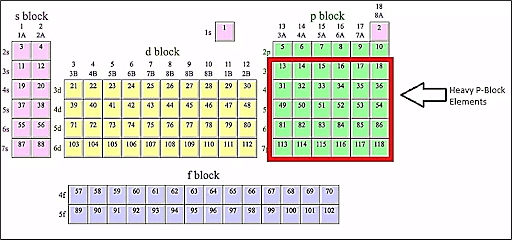
In this article, we will discuss the MCQ-type questions related to the P-block elements with their correct answers. The explanations of those answers will also be included so that while going through these questions, you can also get an opportunity to revise some important points from this chapter. These MCQ questions will also help you to study the concept of p-block elements thoroughly.
Ques. Boron shows diagonal relation with:
(a) Al
(b) C
(c) Si
(d) Sn
Click here for the answer
Ans. (C) Si
Explanation: Boron and Silicon, both of them have similar atomic values and ionization energy. Both show the properties of non-metallic elements. Boron and Silicon both are semiconductors. The acids, like H3BO3 and H4SiO4, formed by Boron and Silicon are weak. Chloride of Boron and Silicon can be hydrolyzed easily. Hence, Boron shows diagonal relation with Silicon.
Ques. Catenation property is maximum in
(a) phosphorus
(b) carbon
(c) sulphur
(d) zinc
Click here for the answer
Ans. (b) Carbon
Explanation: The property of self-linked atoms of any element is called Catenation. It forms chains or rings of different structures. When it comes to Carbon, the process of Catenation is completely natural. Carbon forms covalent bonds which form longer structures with the help of other carbon atoms. Apart from Carbon, Silicon, Boron is also on this list.
Ques. Which one of the following is an electrophilic reagent?
(a) BF3
(b) KH3
(c) H2O
(d) None of these
Click here for the answer
Ans. BF3
Explanation: BF3 can be counted as an electrophile as Boron has three electrons which are coupled with the three electrons that come from the three atoms of hydrogen. Hence, there is total of six electrons in the outer shell. Therefore, to get a stable octet structure, it receives another couple of electrons from a nucleophile.
Ques. Which one of the following is the strongest Lewis acid?
(a) BF3
(b) BCl3
(c) BBr3
(d) Bl3
Click here for the answer
Ans. (b) BCl3
Explanation: Lewis Acids are those chemical species with vacant orbitals, which can receive electron pairs from the Lewis Bases. It is described by the concept of Lewis's theory of acid-base relations. BCl3 is the stronger Lewis Acid among the above mentioned, as it has 3p orbitals on Cl, which is greater than the 2p orbitals on B. Hence, the orbital overlap is less efficient.
Ques. Which of the following is the strongest oxidizing agent?
(a) F2
(b) Cl2
(c) l2
(d) Br2
Click here for the answer
Ans. (a) F2
Explanation: Fluorine is one of the most electronegative elements. So, the formation of F is definitely the most energetic and compatible of the standard reductions. Hence Fluorine is the strongest oxidizing agent. Fluorine is so strong that it reacts even with water.
Ques. The number of P-O-P bonds in cyclic metaphosphoric acid is
(a) 2
(b) 0
(c) 3
(d) 4
Click here for the answer
Ans. (c) 3
Explanation: Meta-phosphoric acid is an eroding, inorganic, cyclic polyphosphate. It is created by the bonded phosphoric acid units. We know that this acid is the oxo-acid of phosphorus, that can form a double bonding with O atom. It can also form a single bond with the OH group. Hence, the number of P-O-P bonds of cyclic metaphosphoric acid is 3. Have a look at the picture below to understand better.
Ques. Which oxide of nitrogen is obtained on heating ammonium nitrate at 250°C?
(a) Nitric oxide
(b) Nitrous oxide
(c) Nitrogen dioxide
(d) Dinitrogen tetroxide
Click here for the answer
Ans. (b) Nitrous oxide
Explanation: Nitrous oxide can be obtained on heating ammonium nitrate at 250°C. Let’s have a look at the equation below to understand this perfectly.
NH4NO3 → N2O + 2H2O
Ques. Atomicity of phosphorus is
(a) 1
(b) 2
(c) 3
(d) 4
Click here for the answer
Ans. (d) 4
Explanation: Atomicity can be defined as the number of atoms that are present in a single molecule. This can be categorized into four kinds- Monatomic, Diatomic, Tri-atomic, and Tetra-atomic. In the case of tetra-atomic, mostly the molecules of the element include four atoms of the same element. Hence, their atomicity is 4. Phosphorus is a tetra-element molecule, so its atomicity is 4.
Ques. The hybridisation of sulphur in sulphur hexafluoride is
(a) sp3d
(b) sp3d2
(c) sp3d3
(d) sp3
Click here for the answer
Ans. (b) sp3d2
Explanation: Hybridization can be described as the technique of mixing two atomic orbitals to create a new type of orbital that is hybridized. These new formations have completely distinguished shapes and energies. The hybridized sp3d2 includes – 1 s, 3 p, and 2 d. Hence, it undergoes the combination of 6 identical sp3d2 hybrid orbitals.
Ques. Which of the following is not correctly matched?
(a) PCl5-sp3d hybridisation
(b) PCl5-sp3 hybridisation
(c) PCl5 (solid)-[PtCl4]– [PtCl3]–
(d) H3PO3 -tribasic
Click here for the answer
Ans. (d) H3PO3 -tribasic
Explanation: The acid that can donate three hydrogen ions to a base during the acid-base reaction is called a tribasic acid. Similarly, if acid has two hydrogen ions to donate, is can be identified as a dibasic acid. In this case, H3PO3 has two hydrogens are attached to the oxygen atoms. Hence, it is a dibasic acid.
Ques. Which of the following is a tetrabasic acid?
(a) Hypo phosphorus acid
(b) Metaphosphoric acid
(c) Pyrophosphoric acid
(d) Orthophosphoric acid
Click here for the answer
Ans. (c) Pyrophosphoric acid
Explanation: The acid that can donate four hydrogen ions to a base during acid-base reaction is called a tetrabasic acid. Pyrophosphoric acid (Hâ,,Pâ,,Oâ‡), has four hydrogens attached to the oxygen atoms. Hence, this is a tetra-basic acid. The structure looks like the following picture.
Ques. Which of the following has maximum ionisation potential?
(a) Al
(b) P
(c) Si
(d) Mg
Click here for the answer
Ans. (b) P
Explanation: To remove an electron from an atom, we need a certain amount of energy. This amount of energy is called ionization energy. As we go down towards the periodical table, this amount keeps decreasing. Similarly, this ionization energy differs from left to right to the periodical table. Now, imagine all the above-mentioned elements as per their places in the periodical table, and if you observe carefully, the position of P in the periodical table gives it the maximum ionization potential among these.
Ques. An element found from seawater is
(a) magnesium
(b) Sodium
(c) Iodine
(d) None of these
Click here for the answer
Ans. (c) Iodine
Explanation: Generally, we know that seawater is salty. It is because of its Iodine content. The upper layer of the seawater contains the maximum amount of Iodine, whereas freshwater has a very low iodine count. Interestingly, even after this huge Iodine count, the seawater only contains 0.8% of total Iodine on the Earth’s crust.
Ques. The shape of XeF4 is
(a) tetrahedral
(b) square planar
(c) pyramidal
(d) linear
Click here for the answer
Ans. (b) square planar
Explanation. There are 4 electron bond pairs and two lone pairs in Xe atom. As the result of undergoing the sp3d2 hybridisation, it represents octahedral electron and square planner molecular geometry. We will understand this more clearly by observing the following image.
Ques. Which one of the following is least basic?
(a) NCl3
(b) NBr3
(c) NI3
(d) NF3
Click here for the answer
Ans. (c) NI3
Explanation. We know that basicity of any element is actually the tendency to supply a lone pair so that both remains basic. As iodine has vacant orbital- d, it can receive long-paired electrons from nitrogen to help in back bonding. The structure of Nl3 looks like the picture below.
For Latest Updates on Upcoming Board Exams, Click Here: https://t.me/class_10_12_board_updates
Check-Out:




Comments